As a K-8 ESOL teacher in the Philadelphia School District, I serve nearly 65 children and families who speak 15 different languages. The most common languages spoken at our school are Bengali, Arabic, Chinese, Spanish & Kazakh. Our school has a growing population of South & Southeast Asian students, as well as families from the Middle East & North Africa. In the larger school community, about 2 out of every 5 students speak another language at home, with over 40 different languages represented. I am constantly thinking of ways to support my students and their families with their language development, both inside and outside of the classroom. From a cognitive science perspective, we have learned that language is not just about communication, but it is fundamental to the way we think, learn, and shape our identity. Moreover, language wields immense power, shaping how we perceive ourselves, others, and the world around us. While our school has a reputation for serving affluent families associated with the University of Pennsylvania, about 40% of our students are economically disadvantaged, especially our immigrant families and students of color. Compared to their native-speaker classmates, our English Language Learners are often vulnerable to economic disparities, discrimination by peers and the community, and even religious intolerance. This unit seeks to empower students, especially English Language Learners, with an understanding of power dynamics and cognitive biases, in hopes of developing better critical-thinking and decision-making skills. By equipping our students with an awareness of their minds and how language can be harnessed to influence, we build their ability to navigate a complex world.
Cognitive Science is an exploration of the human mind, offering insights into how we learn, perceive, and logic. During our studies in the seminar “Introduction to Cognitive Science” with Professor Russell Richie, we delved into the realm of cognitive science, from foundational theories to the complexities of language and decision-making. Professor Richie explained that cognitive science is an interdisciplinary field, “the scientific study of the mind,” drawing from psychology, linguistics, neuroscience, and artificial intelligence. He further explained the idea of cognition as a form of computation, whereby the brain manipulates information. This was explained through F. Donders’s (1868) work on reaction time, whereby mental processes are inferred through behaviors. The Cognitive Revolution of the 1950s and 1960s was a pivotal topic in our class, introducing the computational theory of the mind. We also explored the principles of logic, truth, and meaning, examining how we reason vs. how we do reason, and learning about truth tables and logic statements. Later, in the 1960s and 1970s, Stanford University researchers began a famous experiment, the Marshmallow Task. The study observed how young children could delay gratification by resisting eating a marshmallow and potentially get a larger reward. It showed how cognitive principles can explain human choice and behavior in different contexts. Beyond simply understanding how we think, the field of psychology also delves into metacognition, which explores the extent to which individuals understand their cognitive processes. This involves studying how people reason and reflect on their thinking, a crucial skill that teachers can foster in their students to enhance self-awareness and learning. Further exploring human choice, Professor Ritchie shared one of his lectures on Behavioral Economics, which highlighted that our decisions are not always are rational as we might assume (Ritchie 2025). Behavioral Economics explains that people often make decisions based on feelings, shortcuts, and also on how choices are presented – factors known as biases. For example, people are often “risk-averse” when it comes to potential gains (they would prefer a surer, smaller reward over an uncertain big reward). It also explains how “framing” a choice can influence our decision, even if the options are the same. One example in the slides featured advertising for a toaster. By adding choices, especially a slightly worse option, it could influence the toaster that people would purchase. Human behavior also allows for “nudges,” which subtly guide us towards certain choices. Essentially, our brains can be tricked into making different choices. One of the most poignant lectures from our class prompted the question, “How do people (actually) reason, judge, and decide?” We learned that oftentimes people use mental shortcuts to make decisions and solve problems quickly, based on Kahneman and Tversky’s research into probability judgment (Ritchie, 2025). This session also led to the introduction of the Cognitive Bias Codex, a visual tool that organizes known cognitive biases. It is organized by four major problems that our brains try to solve, including “Too much information, Not enough meaning, Need to Act Fast, and What Should We Remember?” (Manoogian). Given these challenges, understanding cognitive biases is crucial for the effectiveness in making judgements and choices in everyday life. Building on this idea of human decision-making and the impact of our contexts, Professor Ritchie also talked about classic social experiments, such as the Stanford Prison Experiment and the Solomon Asch Conformity Experiments. The infamous Prison study, led by Philip Zimbardo in the 1970s, demonstrated the power of social roles and situational factors on human behavior. He set up a simulation, whereby college students were randomly assigned as “guards” or “prisoners” in a prison environment. The experiment had to be ended after six days, because the guards quickly became authoritarian and abusive, while the prisoners were submissive. The study shows how quickly individuals can conform to roles and how environments can override moral compasses. Similarly, Solomon Asch’s conformity experiments illustrated how individuals could be swayed by group pressure, even if evidence contradicted it. In the study, participants conformed to the incorrect line lengths, illustrating group dynamics on individual judgment. Both studies show how individuals can be manipulated by others and their environments. Language and how we learn language were also recurring topics in the course, exploring the difference between descriptive and prescriptive linguistics. We delved into Chomsky’s contributions and the complexity of language trees. We examined how children acquire language, speaking about the critical periods for learning and syntactic bootstrapping. Professor Richie explored the relationships between language and thought, examining two contrasting views. One view suggests that language is a reflection of thought, meaning that our thoughts exist independently and language serves to express or communicate them. The opposing view, linguistic relativity, suggests that language shapes thought, leading to different perceptions or ways of thinking depending on the language a person knows (Ritchie 2025). As an ESL teacher, the latter idea is compelling, as it suggests that learning a new language may fundamentally alter the way my students perceive and interact with the world. It’s no longer about simply translating ideas across languages, but rather interpreting reality through a new linguistic and cultural lens. Towards the end of our seminar, we also took a trip to the Pennovation Research Lab to learn more about neuroimaging with MRI. We discussed an overview of key brain structures and their functions (medulla, cerebellum, hippocampus, amygdala, cerebral cortex, etc.). We learned that the brain changes in response to experiences. More so, it was fascinating to learn about the brain’s functions surrounding memory. We learned that the brain prunes itself, and “forgetting” is an important part of memory. Essentially, there is a loose “use or lose it rule, whereby Synaptic Connections that receive stimulation get strengthened, while those that do not receive input are weakened or pruned (Ritchie, 2025). This idea brings to mind how easily memories can be manipulated and essentially rewritten, which is a theme in George Orwell’s Animal Farm. In the novel, we see how the pigs exploit the other farm animals, constantly revising history and controlling what they remember while solidifying their power. For instance, the pigs repeatedly alter the commandments written on the barn wall, changing “No animal shall kill any other animal” to without cause or “Animals are equal” to some animals are more equal than others (Orwell). Some of the animals, like Boxer and Clover, sense that something is wrong, but ultimately dismiss their memories in favor of Squealer’s persuasive propaganda. This illustrates the malleability of people under the pressure of manipulation. As I began to conceptualize a unit of study for students, I was intrigued by The Cognitive Bias Codex (June 2018). The document features 188 cognitive biases, grouped into categories and rendered by John Manoogian III as a circle diagram. The category model was developed by Buster Benson, linking biases to corresponding Wikipedia articles by Tilmann R. The visual representation and tool are an interactive way to explore human perceptions and influences on decision-making. The biases are essentially grouped into four main quadrants, addressing a human need or challenge when processing information: 1) What Should We Remember?: These biases affect our memory, essentially how we store memories, how they are reinforced, and how they can be edited or discarded over time. It implies that our accounts are unreliable and can be reshaped. 2) Too Much Information: These biases relate to how we filter information, what we notice, and why we notice it. Our brain essentially takes shortcuts to avoid overload, allowing us to miss important details. 3) Need to Act Fast: These biases influence our decisions when we need to make choices or judgements, favoring things that are familiar or things we are invested in. These biases help us make quicker decisions, which are often flawed. 4) Not Enough Meaning: These biases occur when there is limited information, so people tend to build stereotypes, make assumptions, or simplify the situation. Our mind fills in the gaps, leading to inaccuracies in the narratives. To address the complexities of bias and misinformation in today’s multimedia world, my unit also seeks to integrate the principles of media literacy. As G. Schwarz (2001) argues, media literacy is crucial for developing critical thinking, encouraging reflection on big societal issues, and fostering a deep understanding of who we are as individuals and how we engage with media. Explicitly teaching media literacy “can sensitize students to methods of propaganda, challenge stereotypes in literature – print and non-print – nurture a greater appreciation of the power of language, and promote reading, writing, and disciplined inquiry” (p.113). In addition, by teaching media literacy we can “improve citizenship, preparing students for active engagement in democracy and working against the growing political cynicism that weakens our republic” (p. 114). Students should not just learn about cognitive science as a discipline, but as a gateway to understanding themselves, their biases, the power of language, their metacognition, advertising, consumerism, the effects of media on health, and more. Given this susceptibility, educators should strive to help their students become critical readers of the world. Often, we scrutinize claims from people we don’t know, but readily trust those we do. Therefore, it is essential to explore the questions: When do we trust? Who do we trust? Who is reliable? And critically, why? By exploring these areas, students will be better equipped to navigate the persuasive nature of media in their daily lives and make more informed decisions. We will accomplish this through… By the end of the unit, students will be able to…
As a Teacher of English for Speakers of Other Languages (TESOL), it is my responsibility to utilize the WIDA Standards, focusing on developing English Learners’ Reading, Writing, Listening, & Speaking Domains. The following units are geared to support English Learners in middle school. In many instances, ESOL teachers use both push-in and pull-out models for instruction during the day. This unit, however, would work best in a co-teaching model with the collaboration of the ELA teacher. This collaborative approach seeks to include differentiated instruction, ensuring that the content is accessible for all learners while also building crucial academic language for multilingual learners. Many teaching strategies will be used while working within this unit or developing additional activities. Some highlighted strategies include: Direct Instruction: This strategy involves educators providing a clear explanation or demonstration of a concept or skill. Direct Instruction could be used to explicitly teach vocabulary or cognitive concepts & biases. Direct instruction could look like a brief video or news article, a slideshow, an interactive whiteboard, short lectures with comprehension checks, etc. Jigsaw: Students will become “experts” on different cognitive biases and then teach the concept to the group, utilizing examples in media and in real life. Each group researches their assigned bias, learning the definition, causes, effects, and examples. Groups will then teach their bias to the class. Scaffolding: Providing temporary support to help students complete a task to guide them to mastery. This could include sentence starters, graphic organizers, visuals, etc. These are important strategies when supporting ELLs. Metacognition: Teaching students to think and become aware of their own thinking and learning processes. This strategy would involve prompting students to reflect on how & why they are prone to certain biases. There could even be a journaling component or reflection checkpoints to develop their self-awareness and critical thinking skills. Gallery Walk: This strategy involves students exploring multiple texts or images around the room, working independently or with partners to think critically about a topic. The teacher (or students) will prepare different stations around the room. Students circulate around the stations, analyzing each example. They should be prompted to engage through “turn & talk,” post-it note responses, or another activity. Collaborative Learning: Students should work in groups to read text, discuss the language, and complete tasks. Groups should be flexible both in size and nature. Students can work with partners or small groups to read and analyze complex texts or engage in structured discussions. Case, Project, or Inquiry-Based Learning: Encourage students to investigate cognitive biases in their own lives and the school community. Students may also design a game to apply their understanding and test their knowledge. Be sure to explicitly teach the ethical considerations when researching.
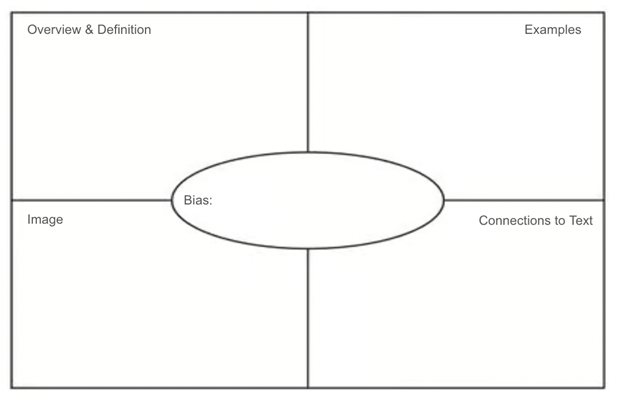
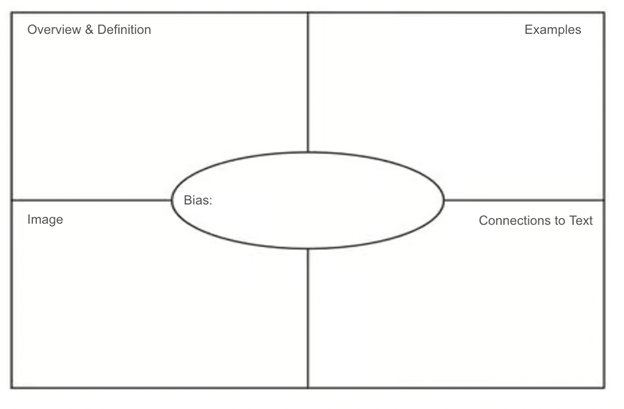
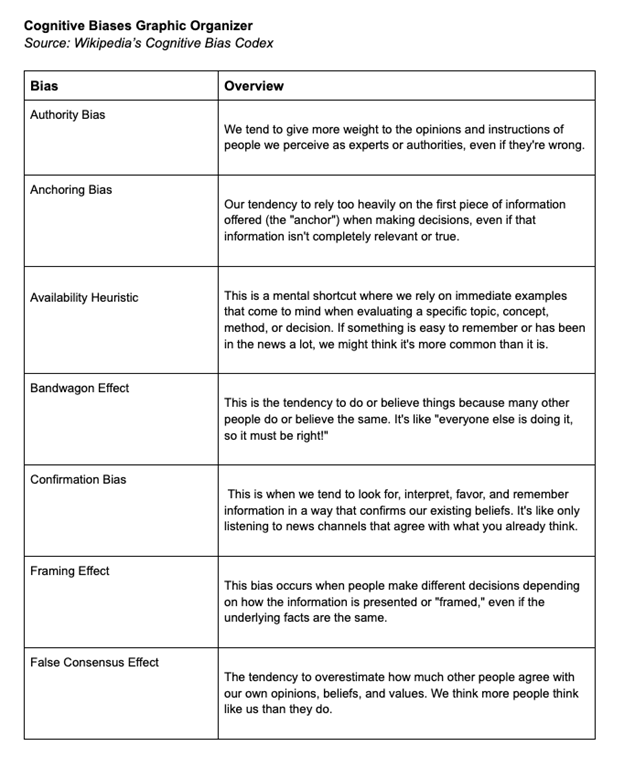
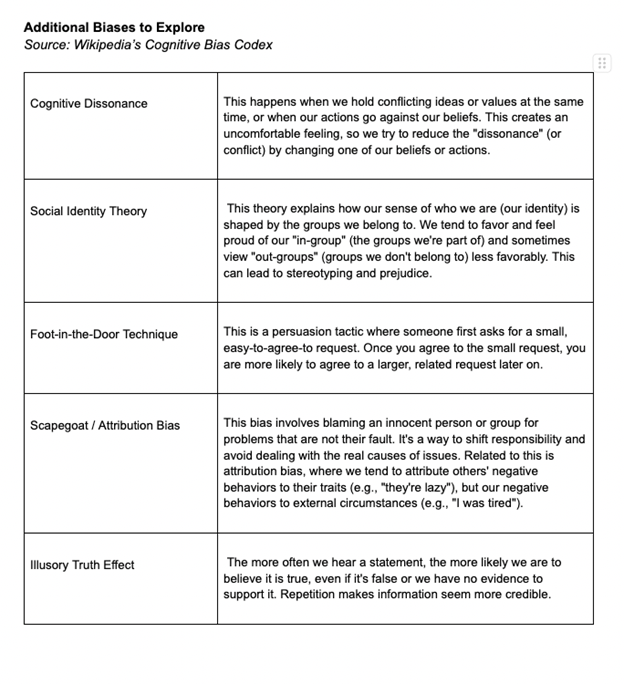
Animal Farm is a required reading text for our 7th-grade ELA curriculum. This unit was designed to be taught in tandem with a prescribed curriculum, but it can also be used to enhance a teacher-made curriculum of the text, in isolation as a mini-unit introducing cognitive biases, or even paired with another dystopian text that explores the power of language. This module seeks to explore a more scientific understanding of how language exerts its power. Drawing on principles from Cognitive Science and Psychology, students will examine the ways words can manipulate our beliefs, decisions, and our reality. Through this, we strive to equip our students with critical thinking tools necessary to discern propaganda and navigate persuasive messaging on social media. Module 1: Cognitive Lens This module will serve as an introduction to cognitive science, understanding how the mind processes information, and further explore how language can manipulate these understandings and beliefs. This module can be taught both before diving into Animal Farm, as well as serve as an introduction while beginning the text, setting the stage for thinking critically about language and decision-making. There are a multitude of different lessons that could help set the stage for a deep dive into Cognitive Science. One possible assignment that educators could set up during the reading of the text would be a Metacognition Journal with prompts and sentence frames for students to respond to during reading. Some journal prompt ideas could focus on: The Power of Words, Emotional Response to Events in the Story, Making Predictions, Analyzing Assumptions, Making Connections, Questioning the Characters & Oneself, Analyzing the Reading Process, etc. FEATURED LESSON #1 Objectives Materials Core Text: Animal Farm by George Orwell, Visual Aid: Cognitive Bias Codex (Available: Wikimedia Commons) Assorted picture books (See Student Reading List) Vocabulary The following vocabulary words can be pre-taught whole class, assigned in small groups, or introduced as they arise. I would recommend creating a visual word wall with examples for the unit, student dictionaries, and/or creating vocabulary graphic organizers to introduce the language with authenticity. TERMS: Cognition, perception, memory, propaganda, bias, critical thinking, conformity, dissonance, social influence, schema (See Appendix for handout) Animal Farm Text Connection Chapter 1 – Old Major’s Speech (Confirmation Bias / Appeal to Emotion) Quote: “Is it not crystal clear, then, comrades, that all the evils of this life of ours spring from the tyranny of human beings? Only get rid of Man, and the produce of our labour would be our own. Almost overnight, we could become rich and free. What then must we do? Why, work night and day, body and soul, for the overthrow of the human race! That is my message to you, comrades: Rebellion!” (Orwell, Chapter 1) Chapter 2 – Pigs’ Leadership (Authority Bias / Bandwagon) Quotes: “The work of teaching and organising the others fell naturally upon the pigs, who were generally recognised as being the cleverest of the animals. Chief among them were two young boars named Napoleon and Snowball…” (Orwell, Chapter 2) “The Seven Commandments would be inscribed on the wall; they would form an unalterable law by which all the animals on Animal Farm must live forever after.” (Orwell, Chapter 2) Hook Marshmallow Test: Begin the journey of delving into Animal Farm by exploring how our brains work. Students will participate in the famous experiment, “The Marshmallow Test.” Explain that the test was originally done with younger children, but it demonstrates how we make decisions. Distribute a marshmallow (or similar treat, such as a chocolate, cookie, or pretzel). Explain to students that they can eat it right away, but if they wait until the timer goes off, they can earn two treats. (Be sure to check for allergies before you begin.) After five minutes (or however long you want to time the students for), open up the classroom discussion about metacognition. For those who ate it right away, what was going through your mind? What made it difficult to wait? Was it a difficult choice? Did you regret your decision? For those who waited, what was going through your mind? What strategies did you use? Where did you look? Did you sing or think about something? How did you resist? What were the hardest parts? Wrap-Up: This was a real-life example of both impulse control (the ability to resist an urge or temptation) and delayed gratification (the idea of waiting for a bigger reward). This test also introduces an entire field of science… Cognitive Science. It is a field that studies how we think, learn, remember, and make decisions. In the text Animal Farm, we will watch some animals grapple with their own decisions and desires, while other animals work to manipulate minds for their power. Lesson Students will be exploring picture books from a cognitive science lens. Assign students into small groups and give them each a picture book (student reading list). They will follow a three-read protocol to examine the text with a different lens. Read One: As a group, students should read the text aloud, listening for story elements. Read Two: Students should record the different types of persuasive language, biases, or manipulations that they notice are taking place in the text. Read Three: Using the cognitive bias codex examples, students should match their book with one of the cognitive biases and explain how the characters are impacted or trying to impact others. Small Group To support ELs or students with diverse needs, the teacher can work with a small group to complete the main task. Some scaffolds that could make the assignment accessible would be 1) Have flagged pages for students to analyze, 2) Have pre-made sentence starters &/or frames for students to use, and 3) Modify the number of examples students need to find. Independent Work or Partner Work Each student or partnership will select one bias from the Cognitive Bias Codex to research. Students should be provided a graphic organizer to complete (See Appendix). Each group will then be responsible for creating one slide about the bias and presenting it to the class. They can use pictures, GIFs, or other examples to help their classmates have a deeper understanding of the bias. Wrap Up Students will present on their assigned bias. Classmates will take notes in a notecatcher (See Appendix) to use as a tool while listening to presentations. They will create their own dictionary of terms, including an image, examples, and an overview. Assessment There are ample opportunities for formative assessment during this lesson, including but not limited to: teacher observation, student graphic organizers, and notecatchers. You may also choose to use the student presentation as a summative assessment. Extension One of the most powerful acts that would follow this lesson would be to have students begin assigning examples from Animal Farm on the notecatcher. Module 2: Identity, Bias, & Animal Farm This module will explore how group identity can shape behavior and decision-making. As students begin to encounter specific instances of propaganda, group dynamics, and manipulation in the text Animal Farm, it will serve as a great opportunity to connect the text examples to cognitive biases, which often stem from our brain’s cognitive shortcuts. This would help to make the abstract ideas within the text more tangible and even relate them to modern-day examples of power and persuasion. Module 2 is intended to dig deeper into different biases, but also make connections to the real world. This would be a great time to enact simulations & role-playing in the classroom, watch videos, or read speeches of persuasive leaders, as well as think critically about the text. This unit also explores different social experiments. Depending on your student population and community, you could research and learn about several famous social experiments, including the Stanford Prison Experiment and Solomon Asch’s Conformity Experiments, to illustrate how group dynamics and situational roles can influence behavior. FEATURED LESSON #2 Objectives Materials Core Text: Animal Farm by George Orwell, Visual Aid: Cognitive Bias Codex (Available: Wikimedia Commons) Student-created materials for social experiments Vocabulary The following vocabulary words can be pre-taught whole class, assigned in small groups, or introduced as they arise. I would recommend creating a visual word wall with examples for the unit, student dictionaries, and/or creating vocabulary graphic organizers to introduce the language with authenticity. TERMS: Nudge Theory, Social Experiment, Ethics, Cognitive Bias, Confirmation Bias, Anchoring Bias, Availability Heuristic, Framing Effect, Conformity, Manipulation Animal Farm Text Connection Chapter 3 – Milk & Apples (Manipulation & Framing) Quote: ” ‘Comrades!’ he cried. ‘You do not imagine, I hope, that we pigs are doing this in a spirit of selfishness and privilege? Many of us actually dislike milk and apples. I dislike them myself. Our sole object in taking these things is to preserve our health. Milk and apples (this has been proved by Science, comrades) contain substances absolutely necessary to the well-being of a pig. We pigs are brainworkers. The whole management and organisation of this farm depend on us. Day and night we are watching over your welfare. It is for your sake that we drink that milk and eat those apples. Do you know what would happen if we pigs failed in our duty? Jones would come back! Yes, Jones would come back!'” (Orwell, Chapter 3) Chapter 3 – Sheep (Conformity & Nudging) Quote: “The sheep had never been in the habit of chanting ‘Four legs good, two legs bad!’ in unison. Now, for the first time, they were taught to do so, and they would often break into a sustained bleating of ‘Four legs good, two legs bad!'” (Orwell, Chapter 3) Hook Social experiment exploring “Nudge Theory”: Nudge Theory is a concept in Behavioral Economics whereby subtle environmental changes will influence people’s behaviors and choices (Ritchie 2025). The teacher will design a “healthy snack bowl” social experiment that allows students to choose snacks over two days. On the first day, the bowls containing both healthy and unhealthy snacks will be separated and placed next to each other. However, on the second day, when it is tied into the lesson, the unhealthy snacks will be located in the same bowl but underneath the healthy snacks at the bottom of the bowl. More healthy snacks should be available to choose from. The teacher can even put a sign that indicates that there are healthy snacks in the bowl. A student or the teacher will record which snacks students select, one at a time. After the results have been tallied, the teacher can reveal the social experiment, introduce nudge theory, and explain ways that people can be influenced. Have students brainstorm other ways that they are nudged into purchases or choices (store layouts, default options). Lesson To begin the lesson, it is first important to introduce the ethical considerations of conducting social experiments, referring to “The Belmont Report” (2014). Explain that “The Belmont Report is organized around three ethical principles: (a) respect for persons, (b) beneficence, and (c) justice.” (Belmont Report 2014) Discuss how these principles mandate protections for vulnerable populations (children, disabled), emphasize the importance of not harming participants and protecting their well-being, and require equitable considerations in research (ex. race, gender, class). While the classroom and school experiments are low-stakes, these ethical considerations are crucial and required for any social science research. As such, each experiment they design needs to be among willing participants. Students will design and plan social experiments. They may choose one of the following experiments or design their own. Once designed, students will implement the experiment, carefully observing the participants’ choices and behavior during their interactions. Students also need to plan for how they will collect data and draw conclusions. They may choose one of the following experiments or design their own: Confirmation Bias – The “Fake News” Filter: Students will design and conduct an experiment where they present two pieces of “news” to a small group. One piece will appear legitimate, but will be a fabricated article or social media post to confirm a common belief. The other will be a factual but counterintuitive piece of information. Students will survey participants about which information they believe and would share. Anchoring Bias – The “Price is Right” Game: Students will create a “Price is Right” style game using everyday items. Before participants guess the actual prices, students will “anchor” them with a very high amount (Is this ___ more or less than $100?) or a very low amount (Is this ___ more or less than $1?). They will then record the participants’ guesses. Availability Heuristic – The Memorable Event: Students will identify two events (one that is highly publicized and one that is statistically more common but less dramatic). They will research actual data on the frequency of both events. They will then design a survey for a small group of participants, asking which events they perceive as more common or anticipate how often they occur. They will compare the results to the data to see if there is an overestimation of frequency. False Consensus Effect – Opinion Polls: Students will create a neutral opinion poll on a non-controversial but common topic. Before participants provide their answer, however, they will be asked to predict the percentage of people who will agree with their own stance. Students will compare the predictions with the actual poll results to see how common it is for individuals to estimate how many people share their opinion. Anchoring – Bake Sale Experiment: Students will plan a mock bake sale scenario to demonstrate biases that influence value and choice. Students could approach the experiment with different scenarios. Anchoring (Initial Price): For specific items, they suggest a very high price (ex. “This cupcake is worth $5, but we’re selling it…”) or very low price (ex. This cookie is worth $1.50…) before allowing participants to state what they would pay. Decoy (Price): For baked goods, they will offer three different sizes. The medium size is priced to be a “decoy” making the large size the better value by comparison. They will record which size the participants choose, noting if the decoy helped the participants toward the higher-priced large option. Framing (Homemade vs Store Bought): They will present identical baked goods, but for some participants the cookies will be labeled as “Grandma’s Homemade Cookies” while others they will be labeled “Store Bought Cookies.” they will observe if the “homemade” framing influences the perceived quality, taste, or willingness to pay even though they are the same. Illusory Truth Effect – The Slogan Power: Students will create simple, short slogans. Some will be true while others will be false, both related to the same topic. They will repeatedly expose a group of participants to the slogans over a short period. Afterwards, they will ask participants to rate the truthfulness of each statement. Students will analyze to see if repeated exposure would increase their perception of truthfulness. Small Group For ELs and/or Students with IEPs, the teacher should already have a structured experiment that they can deliver that is pre-designed with step-by-step instructions. Groups should also be offered graphic organizers and sentence frames. Independent Work After the completion of their group’s social experiment, each student could write a reflection paper. Part One – The paper should critically analyze their chosen experiment, explain the design and the data collected, and explain the cognitive biases that were demonstrated. Part Two – The students should make connections to the events, characters, and themes in Animal Farm. Part Three – The paper should reflect on the broader implications of these biases in real-life scenarios. Wrap Up This lesson could conclude with a Mock “Science Fair” or presentation of the results of the social experiments. Students could create a simple poster board, a digital presentation, or a simple oral presentation. The teacher or students could develop an oral presentation rubric. Assessment Formative- The teacher will assess the groups on their ability to collaborate, design an experiment, and accurately collect data, as well as present their social experiment to the class. Summative – The independent reflection paper with implications and connections will be the primary summative assessment. Module 3: Social Media’s Influence This module will explore how social media platforms, along with the rise of influencers, can manipulate the spread of (mis)information and beliefs. More so, this module allows students to reflect on their understanding of the text(s) and apply them to real-life influencer and marketing scenarios. This module will be heavily influenced by students’ interests when it comes to social media. There are many areas to explore, including the social media algorithm, the psychology of influencer marketing, misinformation in the media, and exploring one’s digital footprint. FEATURED LESSON #3 Objectives Materials Core Text: Animal Farm by George Orwell, Visual Aid: Cognitive Bias Codex (Available: Wikimedia Commons) Gallery Walk Images & Videos – Assorted ads, social media posts, influencer bios Vocabulary The following vocabulary words can be pre-taught whole class, assigned in small groups, or introduced as they arise. I would recommend creating a visual word wall with examples for the unit, student dictionaries, and/or creating vocabulary graphic organizers to introduce the language with authenticity. TERMS: Social media, influencer culture, algorithms, trending, gamification, misinformation, disinformation, Bandwagon, marketing, filter bubbles, Halo Effect, Authority Bias, Loss aversion, Anchoring, Confirmation, Mimicry, Mere-Exposure Effect, Bizareness / Humorous Effect, Clickbait Animal Farm Text Connection Chapter 9 – Squealer’s story of Boxer (Illusory Truth & Misinformation) Quote: “It was the most affecting sight I have ever seen!” said Squealer, blubbering, his eyes brimming with tears. “I was at his bedside at the very last. And at the end, almost at the last moment, he whispered something in my ear… ‘Forward, comrades! Long live Animal Farm! Long live Comrade Napoleon! Napoleon is always right!'” (Orwell, Chapter 9) Chapter 5 – Napoleon’s Halo Effect & Squealer’s Marketing Quote: “No one believed more firmly than Comrade Napoleon that all animals were equal. He would be only too happy to let you make your decisions for yourselves, but sometimes you might make the wrong decisions, and then where should we be? Suppose you had decided to follow Snowball, with his moonshine of windmills – Snowball, who, as we now know, was no better than a criminal?” (Orwell, Chapter 5) Hook To activate prior knowledge, begin by asking, “What do students already know about the world of social media influencers?” Find out what influencers the students follow, and what they know about who they are, how they make their money, and what they do. This could be a brief, while-class brainstorm or quick write. Next, students will watch the video: “Can You Trust Influencers?” from Above the Noise/PBS (Available: Youtube.) This video can be accompanied by an influencer’s slide deck or another teacher-made introduction that gives context and raises key questions. As they watch, they should actively engage with the video by writing down one “notice” (thing they learned or something that stood out to them) and one “wonder” (a question they have), as well as any connections that they may have to the video. After the video, allow them to “turn and talk” to neighbors to discuss their initial reactions and ideas. Then, pivot to a full class discussion about influencers. Lesson This lesson will be broken down into two major components. In the first half of the class, students will find and select different articles to read about social media influencers. The teacher can also provide a list of popular media articles to choose from. They will reflect on the articles and respond to different prompts. Some key ideas to explore: How influencers make money, the psychological reasons why people follow influencers, the ethical responsibilities of influencers, the spread of misinformation, the impact of algorithms on visibility and user feeds, etc. Students will select 1-2 articles to read and be prepared to share and discuss the articles with a partner or group. You can include probing questions or sentence starters to help students engage in discourse. The second portion of the class period will get students up and moving around the room, analyzing influencer videos & ads. The teacher will prepare several “influencer stations” around the room, featuring short video clips or advertisements. If possible, include some of the influencers that the students talked about in the previous portion of the lesson. Students will leave a notice and wonder comments at each location they visit. Students will read and respond to each other’s notes as they also make their way around the room. Encourage students to bring along their notecatcher and vocabulary sheets, to give them the opportunity to discuss the different biases and methods influencers are using to persuade and impact their followers. Small Group ELLS and students with IEPs will be assigned a modified article to read in the first portion of class, potentially in a small group with the teacher. During the gallery walk, encourage them to visit fewer influencer stations and spend more time reflecting using their resources. The teacher can also design structured notecatchers or talking prompts to facilitate discussion. Independent Work or Collaboration Each student will select an influencer of their choice and create a profile about them. They could make a social media profile/baseball card / etc. In the profile, they need to include how the influencer got their start, how they make money, what they promote or sell, and most importantly, the strategies and language they use to influence. Students must also include a dedicated section explaining how the influencer’s tactics mirror events, characters, or themes from Animal Farm. Wrap Up Similar to the beginning of this unit, students will create their gallery of social media influencers. Students will display their influencer profiles in the classroom. During the event, students will have the chance to view each other’s profiles, turn and talk about the diverse strategies, and also make connections across the text. Assessment Summative – The Influencer Profile for the Gallery Walk will serve as the summative assessment for this module. Unit Summative Assessment – At the end of the unit, students will be expected to write an Argumentative Essay about Social Media. One possible prompt could be “To what extent do social media influencers pose a threat to critical thinking and the spread of misinformation?” They should use evidence from Animal Farm, the classroom experiments and discussions, and research about cognitive biases and influencers to support the argument. It is important that educators review the structure and expectations of this essay before assigning it, as well as give time and feedback to brainstorm, draft, and write.
Works Cited Ariely, D. (2008). Predictably Irrational: The Hidden Forces That Shape Our Decisions. HarperCollins.**Learn more about how irrational behaviors are predictable, offering ideas for experiments investigating how children’s choices are influenced by factors like social norms, the power of “free,” and the framing of options. Asch, S. E. (1956). Studies of independence and conformity: I. A minority of one against a unanimous majority. Psychological Monographs: General and Applied, 70(9), 1-70. **This source describes Asch’s conformity experiments. Dehaene, S. (2009). Reading in the brain: The science and evolution of a human invention. Penguin Books. **Understanding the science of the brain in terms of reading, as presented here, can inform effective literacy strategies in the classroom. Department of Health, Education, and Welfare, & National Commission for the Protection of Human Subjects of Biomedical and Behavioral Research. (2014). The Belmont Report: Ethical Principles and Guidelines for the Protection of Human Subjects of Research. The Journal of the American College of Dentists, 81(3), 4-13. *Ethical code that researchers follow when planning and implementing experiments or surveys that involve human participants. Donders, F. C. (1969). On the speed of mental processes. In W. G. Koster (Ed.), Attention and Performance: II (Original work published 1868). Amsterdam: North-Holland. **This research explores reaction time and the speed of mental processes. Gigerenzer, G. (2015). Risk Savvy: How to Make Good Decisions. Viking. **This resource focuses on how people understand and deal with risk. Haney, C., Banks, W. C., & Zimbardo, P. G. (1973). Interpersonal dynamics in a simulated prison. International Journal of Criminology and Penology, 1, 69-97. **This source describes the Stanford Prison Experiment. Immordino-Yang, M. H. (2016). Emotions, learning, and the brain: Exploring the educational implications of affective neuroscience. W. W. Norton & Company. **This book illuminates the interplay between emotions and learning, offering a foundation for creating a supportive learning environment. Kahneman, D. (2011). Thinking, fast and slow. Farrar, Straus and Giroux. ***This book will be one of the core texts I plan to use to inform my curriculum. Manoogian, J. III, & Benson, B. (n.d.). The Cognitive Bias Codex. Retrieved from https://commons.wikimedia.org/wiki/File:Cognitive_bias_codex_en.svg ***This features 188 cognitive biases that can be a visual tool. Marshmallow Test. (n.d.). Simply Psychology. Retrieved from https://www.simplypsychology.org/marshmallow-test.html **This website provides an overview of a key experiment that explains the development of self-control. Meltzoff, A. N., Kuhl, P. K., Movellan, J., & Sejnowski, T. J. (2009). Foundations for a new science of learning. Science, 325(5938), 284-288. **This article offers an overview of the fundamental mechanisms of learning. Orwell, George. (2000). Animal Farm (Reprinted). England: Penguin Books. Richie, Russell. Lectures and Slides. TIP Seminar: Intro to Cognitive Science, University of Pennsylvania, Jan.-May 2025. Schwarz, G. (2001). Literacy expanded: The role of media literacy in teaching education. Teacher Education Quarterly, 28(2), 111. Retrieved from https://proxy.library.upenn.edu/login?url=https://www.proquest.com/scholarly-journals/literacy-expanded-role-media-teaching-education/docview/222856679/se-2 **This article provides an overview of a why media literacy needs to be incorporated in education. Tokuhama-Espinosa, T. (2014). Making classrooms better: 50 practical applications of mind, brain, and education science. W. W. Norton & Company. **This resource translates cognitive science principles into practical classroom applications, offering actionable strategies for educators. Student Reading List “The Wall in the Middle of the Book,” by Jon Agee ***A book about perspective, a tiny knight believes the wall in the middle of the book protects him from the ogre on the other side. *Confirmation Bias “The True Story of the 3 Little Pigs!” by Jon Scieszka ***This book retells the classic story from the big bad wolf’s perspective. *Framing effect, Illusory Truth, “They All Saw a Cat” by Brendan Wenzel ***This book visually demonstrates how different animals perceive the same cat but in different ways. It shows how our nature influences what we see (and don’t). *Naive Realism, Confirmation Bias “Duck! Rabbit!” by Amy Krouse Rosenthal and Tom Lichtenwald ***A picture book where the two narrators of the text debate whether the image is a duck or a rabbit depending on how you look at it. *Ambiguity Bias, Anchoring, Confirmation Bias “Click, Clack, Moo: Cows That Type” by Doreen Cronin ***In this picture book, the farm animals feel exploited and go on strike, using a typewriter to communicate their demands. *In-Group Favoritism, Framing Effect “Farmer Duck” by Martin Waddell ***A hardworking duck is forced to complete farm chores, while the lazy farmer stays in bed. His friends on the farm band together to get rid of the farmer. *Fundamental Attribution Error “Don’t Let the Pigeon Drive the Bus!” by Mo Willems ***The pigeon uses different strategies to convenience the reader to let him drive the bus. *Anchoring, Framing Effect “The Lottery” by Shirley Jackson ***This story critiques how a community blindly follows a custom, even when it is brutal and meaningless. Aesops Fables ***Excellent to introduce and reinforce the concepts of allegory and moral lessons. *Overconfidence effect, Optimism Bias, Social Comparison Bias Albany Herald. (2021, January 27). How 10 popular influencers got their start [Slideshow]. Retrieved from https://www.albanyherald.com/multimedia/slideshows/how-10-popular-influencers-got-their-start/collection_b57752af-f344-59a6-aa0d-fb7ecdd9d47d.html **This slideshow shows the early careers of several well-known social media influencers. Gotter, A. (2024, April 25). Influencer marketing: What it is, how it works, and why it matters. Sprout Social. https://sproutsocial.com/insights/influencer-marketing/ **This guide explains the basics of influencer marketing. Lou, C., & Yuan, S. (2019). Influencer marketing: How message value and credibility affect consumer behavior. Journal of Retailing and Consumer Services, 54, 102021. https://pubmed.ncbi.nlm.nih.gov/31955365/ **This article investigates perceived value and credibility of social media messages and how they impact behavior. TravelMindset. (2024, March 11). 20 influencer marketing examples. Retrieved from https://www.travelmindset.com/20-influencer-marketing-examples/ **This article has various examples of successful influencer marketing campaigns. Zingales, L. (2021, January 13). Propaganda influencers: Paid to spread political disinformation. ProMarket. https://promarket.org/2021/01/13/propaganda-influencers-paid-spread-political-disinformation/ **This article discusses how influencers are paid to disseminate propaganda.
ELD Standards The objectives of the unit will include the following key skills as outlined in the WIDA English Language Development Standards and grade-appropriate Common Core Standards. Appendix B – Student Vocabulary Recorder Appendix C – Unit Vocabulary Source: Merriam-Webster Perception: How you see, hear, smell, taste, and feel the world around you. Memory: Your brain’s ability to store and recall information. Propaganda: Information, especially of a biased or misleading nature, used to promote a political cause or point of view. Bias: A leaning towards or against something; a prejudice. Critical Thinking: The ability to analyze information and make reasoned judgments. Conformity: Changing your behavior or beliefs to fit in with a group. Dissonance: Feeling uncomfortable when your actions don’t match your beliefs. Social Influence: How your thoughts, feelings, and behaviors are affected by others. Schema: A mental framework or concept that helps organize and interpret information. Social Experiment: A research study to investigate human behavior in a social context. Ethics: Moral principles that govern a person’s behavior. Cognitive Bias: A systematic pattern of deviation from the norm or rationality in judgment. Confirmation Bias: Looking for information that only supports your existing beliefs. Anchoring Bias: Relying too heavily on the first piece of information you receive. Availability Heuristic: Making decisions based on readily available examples that come to mind. Framing Effect: How information is presented influences decision-making. Conformity: Adjusting one’s behavior or thinking to coincide with a group standard. Manipulation: Tricking someone into doing what you want. Influencer Culture: A culture centered around individuals with a large following who can influence trends and opinions. Algorithms: A set of rules a computer follows to solve a problem or process data. Trending: Currently popular or widely discussed on social media. Gamification: Applying game-design elements and game principles in non-game contexts. Misinformation: False or inaccurate information, especially that which is deliberately intended to deceive. Disinformation: False information that is intended to mislead, especially propaganda issued by an organization or government to a rival power or the media. Bandwagon: Doing something because many other people are doing it. Marketing: Promoting or selling products or services. Filter Bubbles: When algorithms personalize search results to only show information confirming existing views. Halo Effect: The tendency for a positive impression of a person, company, brand or product in one area to positively influence one’s opinion or feelings in other areas. Authority Bias: The tendency to attribute greater accuracy to the opinion of an authority figure (unrelated to its content) and be more influenced by that opinion. Loss aversion: People’s tendency to prefer avoiding losses to acquiring equivalent gains. Anchoring: A cognitive bias where an individual depends too heavily on an initial piece of information offered (considered to be the “anchor”) when making decisions. Confirmation: The tendency to search for, interpret, favor, and recall information in a way that confirms one’s preexisting beliefs or hypotheses. Mimicry: The action or art of imitating someone or something. Mere-Exposure Effect: A phenomenon by which people tend to develop a preference for things merely because they are familiar with them. Bizarre / Humorous Effect: Bizarre material is better remembered than common material. Clickbait: Content whose main purpose is to attract attention and encourage visitors to click on a link. Appendix D – Three Reads Three Reads – Scaffolded Setting Characters Action Plot Ending The character says… The character thinks… The character asks/tells… Appendix E – Ethical Considerations Checklist Appendix F – Cognitive Biases Graphic Organizer Appendix G – Cognitive Biases
English language learners communicate for social and instructional purposes within the school setting.
English language learners communicate information, ideas, and concepts necessary for academic success in the content area of language arts.
English language learners communicate information, ideas, and concepts necessary for academic success in the content area of mathematics.
English language learners communicate information, ideas, and concepts necessary for academic success in the content area of science.
English language learners communicate information, ideas, and concepts necessary for academic success in the content area of social studies.
Word
Meaning
Examples
Module 1
Module 2
Module 3
Cognition: The way your brain processes information, like thinking, understanding, and remembering things.
Nudge Theory: A concept that suggests subtle changes can influence behavior.
Social Media: Websites and applications that enable users to create and share content or to participate in social networking.
Story Elements
Language
Cognitive Biases
Story Elements
Language
Cognitive Biases
Does your social scenario…
Does your social scenario…