
This unit explores the Science of Learning starting with the essential question “How do People Learn?” In this unit, participants will define learning by drawing from personal and professional experiences, then delve into texts (like Make it Stick) and journal articles that introduce effective learning strategies and explain why they are effective from a cognitive science lens. There will be several assessments that aim to help participants reflect on and evaluate their understanding of The Science of Learning, including reflective narratives, infographics, and learning plans that will give participants the opportunity to demonstrate their understanding of how learning happens, as well as the various obstacles that stand in the way.
Context In my role as an ELA curriculum specialist at the School District of Philadelphia, I am constantly thinking about the teaching and learning that happens in the secondary ELA classroom, particularly as it relates to the students’ deep understanding of complex, grade level text. Understanding is hard to assess or measure, but holistically, the goal of the secondary ELA classroom is for students to confidently and effectively analyze text, discuss text, and write about the text in a way that demonstrates a firm grip on both its content and structure. But there is a problem. Based on the recent 2024 NAEP Reading results, only 19 percent of eighth graders scored proficient or advanced; one could say that less than a quarter of our city’s eighth graders can read grade-level text let alone analyze it at a deep level. This is why there has been a collective district-wide effort for years to increase literacy for our students, with a particular focus on the early grades, since a longitudinal study by Donald J. Hernandez revealed that students who can’t read proficiently by 3rd grade are four times more likely to not graduate high school. One key lever for increasing reading comprehension is having access to background knowledge and word knowledge (vocabulary), and the subsequent ability to retrieve that knowledge when encountering new information. This is where cognitive science comes in — what are the most effective strategies for students to learn new information, store it away, and retrieve this information when it’s needed? The course that I would like to develop will be focused on equipping administrators, coaches, and literacy teachers with a deeper understanding of what is happening in the brain as learning happens and how this impacts what strategies and instructional approaches should be used. My hope is to create a modular professional learning series that answers the simple question, “how do people learn?” with a particular focus on literacy instruction and building background knowledge/vocabulary knowledge. This series will hopefully be available to all administrators, coaches, and secondary ELA teachers at the School District of Philadelphia through various PL programming including Tune Up Tuesday, Office of Curriculum and Instruction supplemental PDs, and the 6-8 FAQ Videos series. The aim of this unit is to bridge our current focus on the Science of Reading with the Science of Learning to ensure that students are not only being exposed to necessary and valuable information, but they’re also given the tools and strategies to effectively engage with this information in a way that deepens their ability to analyze text, talk about text, and write about text inside the ELA classroom and beyond. Essential Question: How do people learn? This unit will be guided by the essential question, “How do people learn?” By starting with this foundational question, participants will be challenged to identify all their existing assumptions about learning and set them aside in order to explore the science of learning and what actually drives deep learning. This essential question will be primarily addressed using the book Make it Stick by Peter C. Brown, Henry L. Roediger III, and Mark A. McDaniel. This book focuses on how people learn through the lens of cognitive science research, and participants will be able to consider how the learning strategies presented in this book can be applied not only in their classrooms, but also in their personal learning journeys, specifically in the realm of literacy instruction. To explore this essential question, this unit will address and unpack the following focus questions: This unit is modular: In each module, participants will not only learn about featured topics, but they will also have opportunities to practice using the strategies and activities that are introduced and then engage with each other to debrief their respective experiences and explore how these instructional methods could be replicated within their classroom contexts. The focus of this modular unit will be on vocabulary instruction, since this will allow participants to focus more on learning strategies as opposed to first learning content (background knowledge), then focusing on strategies. Excerpts from official district professional development captures how vocabulary instructional practices will be first introduced to lay the groundwork for discussing the science of learning and learning strategies at large:
Focus on Vocabulary Instruction
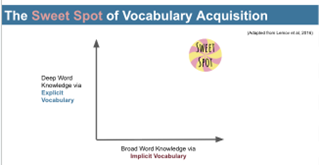
When a word would (and would not) apply:
“Would it be accurate to say that the teacher is foisting homework upon the students? Tell me why or why not.”
To combine multiple new words:
“Could the government foist new taxes on people and also lower taxes on people? “
To narrate the story:
“Can a group foist its values upon another group? Explain how this happened in [insert name of text].”
To define a nuance in the usage of the word:
“How is it different to state that the man foisted cookies upon the customers as opposed to, say, gave away?”
Change the form
In its gerund/noun form, we would say foisting. Write a sentence that includes foisting as a gerund.
Create a sentence with the word and/or other parameters
Write a sentence that includes foist describing a situation in the text that we are reading.
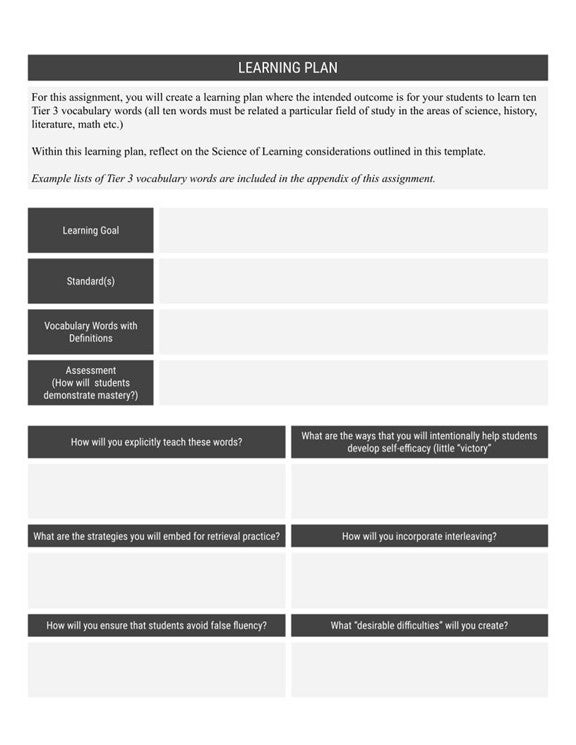
Learning Journey Narrative Participants in this course will first reflect on their own experience as learners by writing a personal narrative that captures their learning journey both inside and outside of the classroom. This retrospective activity will prompt participants to think about their relationship with learning new information, the ways in which learning felt most natural and most challenging to them, and how they would describe an ideal learning environment. This narrative will allow participants to establish their existing beliefs on learning, so that as this unit develops the most effective learning strategies, they will be able to consider this information in light of their personal backgrounds. Science of Learning Infographic As we gain momentum in this unit and cover the most effective strategies for learning (as well as dispel common assumptions on learning that are not true), participants will gradually develop a set of infographics that respectively cover effective learning strategies and ineffective learning strategies. This infographic will have participants synthesize their understanding of how learning works and also serve as a mental model for the Learning Plan that they will create. Learning Plan Participants will create a Learning Plan by first choosing a learning goal that involves learning ten new vocabulary words. Participants will create bite-sized action steps that work towards mastery of this learning goal and include a side-by-side rationale for the learning strategies that are embedded into this plan. Learning Journey Narrative, Revisited Participants will return to their Learning Journey Narrative and write an addendum where they reflect on how this unit deepened their understanding of how people learn and if there are any shifts they’d like to make in their practice as a result.
● Chart Paper ● Markers ● Pencils ● Create a mental model of one’s perception of how they learn ● Reflect on what experiences affected self-efficacy and motivation as a learner ● Have participants come up with a definition for learning and jot it down ● In partners, participants will share their definitions with each other and come up with a collective definition that captures how they think learning should be defined ● Have each pair share their collaborative definition with the whole group Core Instruction ● On chart paper, post the following definition of learning from the book Make it Stick: “acquiring knowledge and skills and having them readily available from memory so you can make sense of future problems and opportunities.” ● In small groups, have participants discuss the following: ○ Growing up, what was something you learned that came naturally to you? ○ What was something you learned that was a product of struggle and failure? ○ Why do you think some things were harder to learn than others? What factors influenced these learning experiences? ● Chart Paper ● Markers ● Pencils ● Create a one-pager that captures learning strategies that can be embedded in ELA instruction ● Post this definition of interleaving for review: ○ Interleaving is a process where students mix, or interleave, multiple subjects or topics while they study in order to improve their learning (The University of Arizona) ● Present this scenario from Make it Stick (page 50) to participants and have them discuss in small groups: ○ Suppose you’re a trainer in a company trying to teach employees a complicated new process that involves ten procedures. The typical way of doing this is to train up in procedure 1, repeating it many times until the trainees really seem to have it down cold. Then you go to procedure 2, you do many repetitions of 2, you get that down, and so on. That appears to produce fast learning. What would interleaved practice look like? Core Instruction ● Participants draft a list of learning strategies that were covered during this course and write down example classroom scenarios in which they might be implemented ● Participants will create infographics that capture 4-5 learning strategies using the templates provided ● After independent work time, participants will have the opportunity to do a gallery walk to view each other’s infographics and write down 3-4 additional learning strategies that they would like to reference during the school year ● Chart Paper ● Markers ● Pencils ● Participants will embed 2-3 learning strategies covered during the course and explain the cognitive rationale behind their effectiveness in memory retrieval ● Have participants read an excerpt from the article, “On the Difficult of Mending Metacognitive Illusions: A Priori Theories, Fluency Effects, and Misattributions of the Interleaving Benefit” (pages 931-932 – “General Discussion”) ● Have them discuss the following: ○ What is the difference between blocked and interleaved study? ○ From your personal experience as a learner, which form of learning was encouraged more in the classroom? ○ What is the “metacognitive illusion” that this article references? ○ How do you think this metacognitive illusion can be addressed? Core Instruction ● Participants will choose ten vocabulary words from a specific content area/topic (Tier 3 words) ● Using the template, participants will consider the following: ○ How will you explicitly teach these words? ○ What are the ways that you will intentionally help students develop self-efficacy (little “victory” ○ What are the strategies you will embed for retrieval practice? ○ How will you incorporate interleaving? ○ How will you ensure that students avoid false fluency? ○ What “desirable difficulties” will you create? ● With a partner, participants will share their learning plan and provide peer feedback, specifically focusing on the following considerations: ○ Are the ten words from the same topic/content area? ○ Does each vocabulary word come with a student-friendly definition? ○ What are the ways that these words will be explicitly taught? ○ What opportunities are there for students to practice using these words? ○ How does this learning plan specifically address how to avoid false fluency? ○ How will students demonstrate mastery? Source: Ditch That Textbook ● Chart Paper ● Markers ● Pencils ● Reflect on what experiences affected self-efficacy and motivation as a learner ● Have participants pull out their Learning Journey Narrative from the beginning of this course and read it. ● Have them jot down some learning strategies and concepts covered in this course that might have influenced their experience as learners. Core Instruction ● In their Learning Journey Narrative, Revisited Template — have them consider: ○ What are some of the learning strategies covered in these modules that you plan to incorporate moving forward in your practice? ○ How does your understanding of the Science of Learning illuminate the learning experiences that you had personally, and those of the people you support professionally? ○ Think of something you would like to learn in the next month. What learning strategies do you hope to incorporate in this experience? ● In a whole group discussion, participants will share 1-2 insights from their reflection. Classroom Activities
Lesson Example #1
Title
Learning Journey Narrative
Materials
● Learning Journey Narrative Handout
Objective
● Discuss and define “learning”
Standard
Danielson Domain 4a
Step by Step
Opening
Assessment
Learning Journey Narrative
Lesson Example #2
Title
Science of Learning Infographic
Materials
● Science of Learning Infographic Templates
Objective
● Understand effective learning strategies that reinforce memory retrieval
Standard
Danielson Domain 1a
Step by Step
Opening Activity
Assessment
Science of Learning Infographic Templates
Lesson Example #3
Title
Learning Plan
Materials
● Learning Plan Template
Objective
● Participants will create a coherent learning plan that leads to the mastery of an intended outcome related to learning ten vocabulary words
Standard
Danielson Domain 1e
Step by Step
Opening Activity
Assessment
Learning Plan Template
Lesson Example #4
Title
Learning Journey Narrative, Revisited
Materials
● Learning Journey Narrative, Revisited Handout
Objective
● Create a mental model of one’s perception of how they learn
Standard
Danielson Domain 4a
Step by Step
Opening Activity
Assessment
Learning Journey Narrative, Revisited
“Analogical Problem Solving” (Gick and Holyoak, 1980), reasoninglab.psych.ucla.edu/wp-content/uploads/sites/273/2021/04/Gick-Holyoak1980Analogical-Problem-Solving.pdf. Accessed 5 June 2025. Brown, Peter C. Make It Stick : the Science of Successful Learning. Cambridge, Massachusetts :The Belknap Press of Harvard University Press, 2014. Dotan, Dror, and Sharon Zviran-Ginat. “Elementary math in elementary school: The effect of interference on learning the multiplication table.” Cognitive Research: Principles and Implications, vol. 7, no. 1, 2 Dec. 2022, https://doi.org/10.1186/s41235-022-00451-0. Fisher, Douglas, et al. Teaching Foundational Skills to Adolescent Readers. Corwin Press, 2025. Khamesipour, Marzieh. “The Effects of Explicit and Implicit Instruction of Vocabulary through Reading on EFL Learners’ Vocabulary Development.” Theory and Practice in Language Studies, vol. 5, no. 8, 2015, www.academypublication.com/issues2/tpls/vol05/08/11.pdf. “Leveraging Analogies.” Jeremy Utley, Jeremy Utley, 22 July 2021, www.jeremyutley.design/blog/leveraging-analogies. Liben, David, and Meredith Liben. Know Better, Do Better: Teaching the Foundations so Every Child Can Read. Scholastic Inc, 2024. Nuthall, Graham. The Hidden Lives of Learners. NZCER Press, 2007. Lemov, Doug, et al. Reading Reconsidered: A Practical Guide to Rigorous Literacy Instruction. Jossey-Bass & Pfeiffer Imprints, Wiley, 2016. “Spaced Repetition.” Wikipedia, Wikimedia Foundation, 25 May 2025, en.wikipedia.org/wiki/Spaced_repetition. Tullis, Jonathan G., and Robert L. Goldstone. “Why does peer instruction benefit student learning?” Cognitive Research: Principles and Implications, vol. 5, no. 1, 9 Apr. 2020, https://doi.org/10.1186/s41235-020-00218-5. Weinstein, Yana, et al. “Teaching the science of learning.” Cognitive Research: Principles and Implications, vol. 3, no. 1, 24 Jan. 2018, https://doi.org/10.1186/s41235-017-0087-y. Wexler, Natalie. Beyond the Science of Reading: Connecting Literacy Instruction to the Science of Learning. Association for Supervision & Curriculum Development, 2025. Willingham, Daniel T. Why Don’t Students Like School?: A Cognitive Scientist Answers Questions About How the Mind Works and What It Means for Your Classroom. Jossey-Bass, 2010. Yan, Veronica X et al. “On the difficulty of mending metacognitive illusions: A priori theories, fluency effects, and misattributions of the interleaving benefit.” Journal of experimental psychology. General vol. 145,7 (2016): 918-33. doi:10.1037/xge0000177 Young-Davy, Belinda. “Explicit Vocabulary Instruction.” ORTESOL Journal, vol. 31, 2014, pp. 26-32.
This framework is used to provide feedback to and evaluate teachers at the School District of Philadelphia • Content knowledge • Prerequisite relationships • Content pedagogy 1b Demonstrating Knowledge of Students • Child development • Learning process • Special needs • Student skills, knowledge, and proficiency • Interests and cultural heritage 1c Setting Instructional Outcomes • Value, sequence, and alignment • Clarity • Balance • Suitability for diverse learners 1d Demonstrating Knowledge of Resources • For classroom • To extend content knowledge • For students 1e Designing Coherent Instruction • Learning activities • Instructional materials and resources • Instructional groups • Lesson and unit structure 1f Designing Student Assessments • Congruence with outcomes • Criteria and sta • Teacher interaction with students • Student interaction with students 2b Establishing a Culture for Learning • Importance of content • Expectations for learning and achievement • Student pride in work 2c Managing Classroom Procedures • Instructional groups • Transitions • Materials and supplies • Non-instructional duties • Supervision of volunteers and paraprofessionals 2d Managing Student Behavior • Expectations • Monitoring behavior • Response to misbehavior 2e Organizing Physical Space • Safety and accessibility • Arrangement of furniture and resources •Accuracy • Use in future teaching 4b Maintaining Accurate Records •Student completion of assignments • Student progress in learning •Non-instructional records 4c Communicating with Families •About instructional program • About individual students • Engagement of families in instructional program 4d Participating in a Professional Community •Relationships with colleagues • Participation in school projects •Involvement in culture of professional inquiry • Service to school 4e Growing and Developing Professionally •Enhancement of content knowledge / pedagogical skill • Receptivity to feedback from colleagues • Service to the profession 4f Showing Professionalism •Integrity/ethical conduct • Service to students • Advocacy • Decision-making • Compliance with school/district regulation • Expectations for learning • Directions and procedures • Explanations of content • Use of oral and written language 3b Using Questioning and Discussion Techniques • Quality of questions • Discussion techniques • Student participation 3c Engaging Students in Learning • Activities and assignments • Student groups • Instructional materials and resources • Structure and pacing 3d Using Assessment in Instruction • Assessment criteria • Monitoring of student learning • Feedback to students • Student self-assessment and monitoring 3e Demonstrating Flexibility and Responsiveness • Lesson adjustment Learning Journey Narrative 1) “First to be useful, learning requires memory, so what we’ve learned is still there later when we need it.” 2) “Second, we need to keep learning and remembering all our lives.” 3) ‘Third, learning is an acquired skill, and the most effective strategies are often counterintuitive.” In this personal narrative, reflect on yourself as a learner and draw from experiences that happened both inside and outside of the classroom. Consider 2-3 of the following prompts to get you started: ● Growing up, what was something you learned that came naturally to you? ● What was something you learned that was a product of struggle and failure? ● What is something you have recently learned (either a process like learning how to bake a cake or a concept like learning how vocabulary acquisition works for students) and what were some of the key strategies that helped you along the way? ● Of the Make it Stick quotes above, which ones resonate with you immediately and which assertions require you to take a step back and ponder? ________________________________________________________________________________________________________________________________________________________________________________________________________________________________________________________________________________________________________________________________________________________________________________________________________________________________________________________________________________________________________________________________________________________________________________________________________________________________________________________________________________________________________________________________________________________________________________________________________________________________________________________________________________________________________________________________________________________________________________________________________________________________________________________________________________________________________________________________________________________________________________________________________________________________________________________________________________________________________________________________________________________________________________________________________________________________________________________________________________________________________________________________________________________________________________________________________________________________________________________________________________________________________________________________________________ Learning Journey Narrative, Revisited Questions to consider: ● What are some of the learning strategies covered in these modules that you plan to incorporate moving forward in your practice? ● How does your understanding of the Science of Learning illuminate the learning experiences that you had personally, and those of the people you support professionally? ● Think of something you would like to learn in the next month. What learning strategies do you hope to incorporate in this experience? ________________________________________________________________________________________________________________________________________________________________________________________________________________________________________________________________________________________________________________________________________________________________________________________________________________________________________________________________________________________________________________________________________________________________________________________________________________________________________________________________________________________________________________________________________________________________________________________________________________________________________________ Science of Learning Infographic Templates Learning Plan Template Tier 3 Vocabulary Lists (examples) Appendix
Danielson Framework
DOMAIN 1: Planning and Preparation
DOMAIN 2: The Classroom Environment
1a Demonstrating Knowledge of Content and Pedagogy
2a Creating an Environment of Respect and Rapport
DOMAIN 4: Professional Responsibilities
DOMAIN 3: Instruction
4a Reflecting on Teaching
3a Communicating With Students
In Make it Stick, learning is described as “acquiring knowledge and skills and having them readily available from memory so you can make sense of future problems and opportunities.” The book asserts that there are three foundational aspects of learning:
Take a moment to read through the Learning Journey Narrative that you wrote at the beginning of this course. Consider how the concepts in these modules influenced your understanding of yourself as a learner and learning in general.
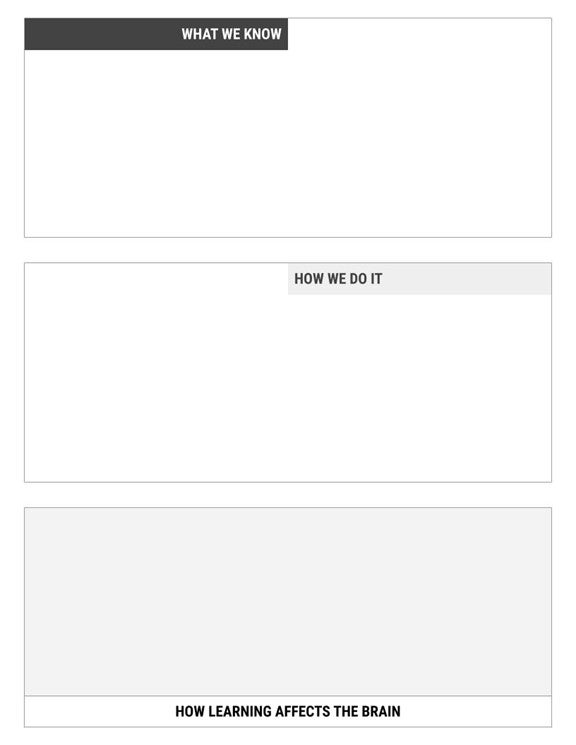
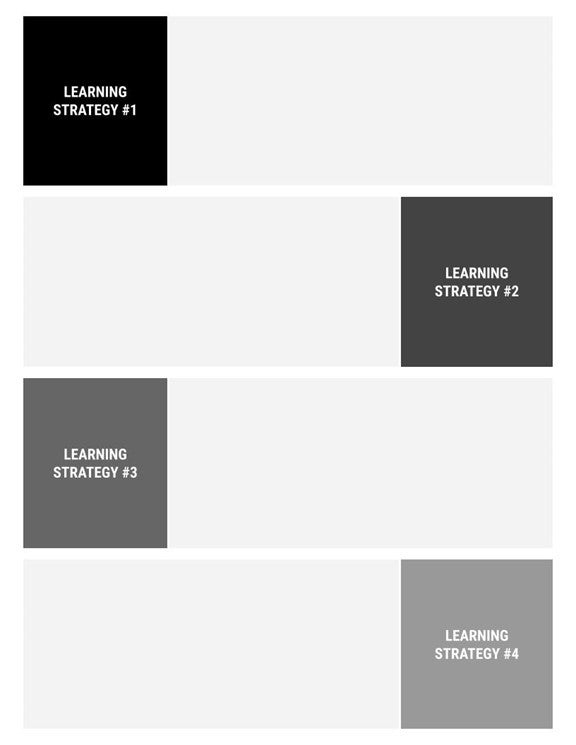
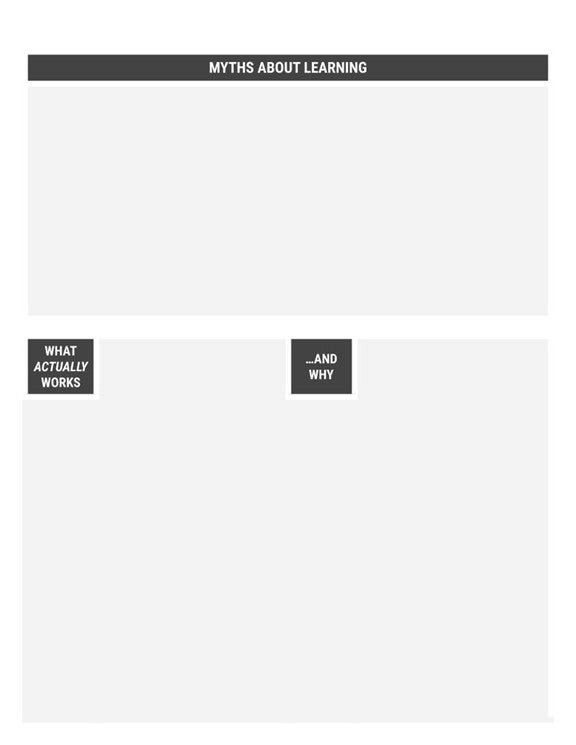
List 1: Science & Technology Focused
List 2: Humanities & Arts Focused
List 3: Business & Economics Focused