
Imagine students learning fractions grounded in evidence-based cognitive models, carefully tailored to how the brain learns best. This Math curriculum unit is written as a framework to help learners maximize their mastery of fractions. In addition, the unit incorporates the principles of swarm intelligence – an approach of collective learning behaviors and decision-making – inspired by natural systems like bird flocks and ant colonies and based on a decentralized, self-organizing system. Students work together using simple rules of social interaction to optimize a creation for a project-based design, such as a mosaic, universal flag, or garden, that benefits and serves the community. This fraction unit addresses the following 5th Grade Math Common Core State Standards: 5.NF.B.4, and 5.NF.B.6., and is intended to complement and enhance any existing math curriculum rather than replacing it with more content. Specifically, it builds on activities from Units 2, 3, and 6 of the Illustrative Mathematics (IM) program, recently adopted by my school district in Philadelphia. Titled Cognitive Models for Fractions Mastery, the unit integrates the following cognitive models:
The unit aims to improve student long-term retention, deepen conceptual understanding, and minimize excessive information with daily lessons, weekly homework, and end-of-unit reviews. In addition, through the integration of a swarm learning model, learners are encouraged to actively participate in a collaborative design challenge that emphasizes adaptive problem-solving and real-world application of fractions. Students will “build together” to create a 2D or 3D design composed of fractional parts. Incorporating these cognitive models will significantly reshape fraction instruction through the reinforcement of mastery, real-world application, and open-ended exploration.
“A brain is a system of neurons so deeply interconnected that an intelligence forms. A swarm is a system of brains so deeply interconnected that a superintelligence forms.”1 From the above definitions of a brain and a swarm, Dr. Louis Rosenberg (2015), an American engineer, inventor, entrepreneur, and founder of Unanimous A.I., concludes that a swarm “operates as a brain of brains” and therefore, serves as a good model to optimize emergent collective intelligence and behaviors.2 Of course, this doesn’t imply that any swarm of individuals automatically outperforms the superpower of a brain like that of Albert Einstein. However, a swarm that includes Einstein as a member can arguably outperform Einstein alone. In addition, the swarm intelligence model referenced here should not be confused with the metaphor of “being a sheep,” where an individual blindly follows the group or its shepherd (leader) without questioning or challenging their directions. The swarm model offers a powerful alternative to traditional decision-making methods like voting, polling, surveys or consensus where the majority rules, to unlock the best potential of collective wisdom as students behave, explore, decide, do math, and create together synchronously. For this math curriculum unit on fractions mastery, I’ve organized the following eight cognitive models into four (4) key instructional goals to be used throughout the school year: 1) spaced practice, interleaved practice, and retrieval practice for retention and mastery;3 2) elaboration, concrete examples, and dual coding to deepen conceptual understanding;4 3) cognitive load theory to solicit student feedback to minimize excessive information:5 4) swarm intelligence to achieve an optimal but non-hierarchical design to beautify the school.6 Breakdown of the eight (8) cognitive models that are used: Practice Practice (Supports Metacognition) Representational- Abstract (CRA) Approach verbal explanations (words, etc.) Intelligence (SI) My participation in the seminar Introduction to Cognitive Science: Uncovering the Machine in the Mind, led by Professor Russell Richie of Penn MindCore at the University of Pennsylvania, expanded my knowledge of evidence-based cognitive models that can support fraction mastery for students in grades 3rd through 5th. Rather than replacing a school’s existing math curricula, this fraction unit is intended to complement and enhance them. Specifically, it builds on 5th grade activities from Units 2, 3, and 6 of the Illustrative Mathematics (IM) curriculum, recently adopted by my school district.7 Below is an approximated pacing of how I teach fractions to my 5th graders throughout the year. Rationale Problem #1: Why Focus on Fractions? As a 5th-grade math teacher with over 24 years of classroom experience, I’ve witnessed year after year that a significant number of students entering 5th grade (typically about two-thirds of a class) struggle with fractions. Disappointingly, most of these students show little to no improvement by the end of that school year. When a student doesn’t master a solid understanding of fractions in the 5th grade, their progress often stalls in later years. This reality is compounded by several factors: the “math genius” myth, learned helplessness, math anxiety, and the difficulty students face when transitioning from their strong understanding of the whole number system to the more complex logic of fractions.8 It is particularly challenging to change the mindset of students who have internalized the belief, “I’m just bad at math,” Therefore, I believe that it is essential for these early math learners to understand that intelligence is not fixed and math ability grows with persistent practice and hard work.9 The cognitive science of neuroplasticity reinforces this idea that the brain is capable of change and growth in response to experiences, especially when learning is supported in the right way (Turrini et al., 2023).10 Research consistently highlights the crucial role of fraction understanding in overall mathematics achievement, particularly in middle school and high school.11 Fractions mastery is the foundational building block for understanding and succeeding in high school algebra, higher-level math, and a wide range of future careers—not only in STEM fields and finance but also in skilled trades like electrical work, as well as in music and the culinary arts. Outside of the classroom, fractions are embedded in our everyday life, including measuring spaces for home renovation, cooking with recipes, telling time, and calculating sales discounts. In short, a strong understanding of fractions is key to both academic success and practical life skills. Problem #2: The Rules for Fractions Make No Sense! One of the biggest hurdles in learning fractions is the shift from a strong understanding of the whole number system, which often contradicts the specific rules relating to fractions. For instance, when a whole number is divided by another whole number, the answer is less than the first whole number (e.g., 8 ÷ 4 = 2). But when a whole number is divided by a fraction, the answer is greater than the whole number (e.g., 8 ÷ = 32). This concept is confusing and counterintuitive to many children as well as adults. To address this, we might consider teaching operations more flexibly, encouraging students to see how addition, subtraction, multiplication, and division are interconnected and can be used to solve the same problem in different ways. For instance, 8 ÷ 4 = 2 can be understood as: Repeated addition: 2 + 2 + 2 + 2 = 8 (it takes four additions of 2). Repeated subtraction: 8 – 4 – 4 = 0 (it takes two subtractions of 4). Multiplication: 2 × 4 = 8 or 4 × 2 = 8 (the inverse operation of division). Similarity with fractions, 8 ÷ = 32 can be understood as: Repeated addition: How many add up to get 8? The answer is 32. Repeated subtraction: How many subtract from 8 to get 0? The answer is 32. Multiplication: 32 × = 8, demonstrating that division by a fraction is the inverse of multiplying by that same fraction. By helping students explore these relationships, teachers can demystify fraction operations and empower students to approach math problems with greater flexibility. In summary, manipulating fractions becomes difficult for many students when they struggle to reconcile their prior knowledge of whole numbers with the unique properties of fractions. Each mathematical operation with fractions often comes with a different set of procedures, which can easily overwhelm learners. Additionally, for students new to fractions, there is often a weak or missing neural connection between fraction concepts and the foundation of number sense developed since kindergarten. There is a clear progression in how fractions are introduced and taught across the elementary grades based on the Math Common Core State Standards (CCSS), released in 2010. In 1st and 2nd grade, fractions are introduced informally using real-world contexts, like dividing a pizza, or a cake, often represented as parts of a circle labeled with common unit fractions ( , , , , , or ). Less common unit fractions like , , or are typically avoided at this stage due to their association with repeating decimals, which are considered more abstract and difficult to visualize for early learners. When students are introduced to fractions in 3rd grade, for them to succeed in fractions mastery, they have to differentiate the new understanding of fractions from their existing understanding of whole numbers. One crucial connection is to show students that whole numbers can be expressed as fractions with a denominator of 1 (e.g., the whole number 5 can be written as with the integer 5 in the numerator representing the number of pieces and the integer 1 in the denominator representing the size of each piece equals to 1 whole). Recognizing this connection helps students understand that both whole numbers and fractions are rational numbers that can be expressed as a ratio of two integers. In addition, it is essential to point out to students that fractions represent parts of a whole, allowing for more precise calculations and comparisons than whole numbers. Highlighting these connections early in school supports deeper conceptual understanding and prepares students for more advanced mathematical thinking. In 3rd grade, formal math instruction of fractions begins. Students learn to work with unit fractions using visual models – such as fraction tiles, number lines, and area models – to represent fractional values and relationships. In 4th grade, fractions instruction expands to include equivalent fractions, comparing and ordering fractions, and basic operations (especially addition and subtraction of like denominators). Students are also introduced to mixed numbers and fractions greater than one (formerly known as improper fractions). In 5th grade, students move into more complex operations, including adding and subtracting fractions with unlike denominators, multiplying fractions, dividing whole numbers by fractions or vice versa, and solving multi-step word problems involving fractions and mixed numbers. By 6th grade, students are expected to deepen their understanding by converting between “fractions greater than one” and mixed numbers, finding common denominators, and applying their knowledge in more real-world contexts. Mastery of all four operations (addition, subtraction, multiplication, and division) is emphasized at this stage. Ultimately, building a strong understanding of fractions across the grade levels is essential for long-term math success. Problem #3: Learners Forget Quickly. Research has shown over and over again that when taking in new information, a learner may understand 100% of the material at the time of learning. However, learners forget an average 50% of the information presented within one hour, 70% within 24 hours, and up to 90% within a week.12 This phenomenon is often referred to as Ebbinghaus’ Forgetting Curve, hypothesized by the German psychologist Hermann Ebbinghaus in 1885, with the conclusion that memory loss increases exponentially immediately after a learning event.13 Most math curricula in the United States use the “block practice” to sequence the teaching of fractions where students repeat the similar math operation or the same procedures multiple times in a short time frame of one to three weeks before moving on to a new skill.14 For instance, with my district-wide program, Illustrative Math (1M), founded in 2011 at the University of Arizona, the teaching of fractions is concentrated in Units 2, 3, and 6. Unit 2 focuses on “Fractions as Quotients and Fraction Multiplication,” with 17 lessons.15 Unit 3 focuses on “Multiplying and Dividing Fractions,” with 20 lessons.16 This means the adding and subtracting of fractions is not formally addressed until Unit 6 which is misleadingly titled “Decimal and Fraction Operations,” with 21 lessons.17 This sequence does not clearly examine the concept of “decimal fractions,” fractions like , , and where the denominator is in the power of 10 which makes the conversion of these fractions into decimals easily done with a decimal point and place value understanding. What if 5th grade students practice adding fractions daily and with ease comparable to how pre-K students sing the alphabet song and counting numbers from 1 to 100? My current district-wide math program is designed to teach one topic to the next at a rapid pace with little to no time for spaced, interleaved, and retrieval practices. What if math instruction is taught with more emphasis on how a student’s prior knowledge is connected to new and old concepts, how overlearning can strengthen retention rate, and how more periodic repeated reviews of skills can develop deeper understanding of fractions? Problem #4: Students Are at Different Levels of Fraction Understanding. The needs of multilingual and special needs students are sometimes sacrificed in order to cover all the topics in a school district’s mandate pacing schedule. Due to time constraint (often a daily block of 90 minutes for math), large class size, and the diverse needs of students, teachers often feel like they have to “dumb down” the math content in order to make it through the day. The Illustrative Math (IM) program in my district begins each math lesson with an opening routine, lasting approximately 5 to 10 minutes, aimed at sparking authentic student discussion. However, from my last three years of using this district-wide math curriculum, most of my students (the majority are multilingual learners) have difficulties verbally articulating their mathematical thinking with such a time constraint. I want to incorporate instructional routines and classroom activities that are easily accessible for students to improve their retention and deepen their cognitive reasoning and understanding of fractions. Problem #5: “Doing Math” Alone Is Not Fun! Traditionally, “doing math” is mainly a solitary thinking process that inevitably separates students into two distinct camps: those who can do math and those who can’t. This math unit challenges that notion of how math is taught by introducing a more risk-taking learning model inspired by the swarm intelligence of bird flocks as a potential paradigm shift in math instruction. The swarm learning model promotes a decentralized system, where collaboration emerges with a few simple rules relating to student behaviors and interactions. The goal is to create a more inclusive and dynamic math community and environment, where learning is self-organized, flexible, and triggered by social interactions rather than fixed leadership, or rigid “camp structures.” The traditional approach often divides students by perceived ability, isolates those who feel they struggle with math, and stigmatizes those who genuinely enjoy it. My School Demographic Currently, I teach 5th grade at the Francis Scott Key School, a Kindergarten to 6th grade public school, in South Philadelphia, Pennsylvania. For the School Year 2024-2025, the school serves an estimated 376 students, of whom 47% are female students and 53% are male students; 100% of students are classified as economically disadvantaged.18 The student population is highly diverse, with 94.4% identifying as minority and 5.6% as White; the student diversity breakdown is approximately 55.9% Hispanic/Latino, 29.3% Asian or Pacific Islander, 7.4% Black, 1.3% identifying as two or more races, and 0.5% Native Hawaiian or Other Pacific Islander.19 The student-teacher ratio is 11:1, which is better than that of the district.20 Based on the 2024 Pennsylvania state test, only 9% of students scored advanced or proficient in math, and 21% in reading.21 According to Niche.com, the median household income is $79,023, the median rent is $1,541, and the median home value is $246,841 for the area where my school is located.22 The neighborhood’s median household income, rent, and median home value continue to rise over the past 10 years, largely due to gentrification – an influx of more affluent residents and displacement of more low-income residents leading to increased property values. The school community is highly diverse with a wide range of cultural and language backgrounds. According in-house school data for 2024-2025, Francis Scott Key School provides English for Speakers of Other Languages (ESOL) services to roughly 250 students (71% of the student body) and Learning Support services to approximately 40 students (11% of the student body).23 Despite this support, academic achievement remains a difficult challenge. Students, families, and school staff speak a wide variety of languages, including but not limited to: Arabic, Burmese, Chinese, French, Hindi (India), Indonesian, Italian, Karen (Myanmar and Thailand), Khmer (Cambodia), Korean, Laos, Malays, Nahuatl (Aztec/Mexica), Nepali, Pashto (Afghanistan and Pakistan), Poqomchi (Guatemala), Q’eqchi’(Central America), Spanish, Swahili, Thai, Vietnamese, and other Indigenous languages. The 5 most spoken languages are: Spanish, Khmer, Burmese, Urdu, and Mandarin, and newly emerging languages include Urdu (Pakistan) and Arabic (Algeria), reflecting the school’s ongoing demographic shifts and the growing diversity of its multilingual learners. Unit Content Based on research conducted by Marsha C. Lovett and Joel B. Greenhouse at Carnegie Mellon University (2000), which applied cognitive theory to instruction of statistics, five key principles emerged to support effective cognitive learning:24 Cognitive learning is a theory that focuses on the internal mental processes that help learners acquire and retain knowledge, as opposed to the behavioral learning theory, which relies on external stimuli such as rewards and classical conditioning. When a person learns something new, a mental connection is formed between two previously unconnected neurons. One common method to maximize learning effectiveness is to offload irrelevant procedures and use scaffolding techniques to make essential information more accessible and easier to grasp. According to the book Make It Stick: The Science of Successful Learning by Brown, Roediger, & McDaniel (2014), very few teacher trainings and textbooks cover how cognitive science can be used successfully in the classroom.25 Even though research-based strategies rooted in cognitive science have been shown to enhance student learning for several decades, a formal application to education practices is a fairly new development with more recent surge in the last 10-15 years.26 A report by the cognitive scientist Hal Pashler and his colleagues (2007) identifies six key evidence-based learning strategies: spaced practice, interleaved practice, retrieval practice, elaboration, concrete examples, and dual coding.27 Cognitive Model #1: Spaced Practice With space practice, also known as “distributed practice,” students encode new materials over multiple sessions spaced out over time, and studies have shown significant gains in long-term retention, conceptual understanding, and task performance.28 It’s important to note that spaced practice refers to repeated exposure to the same information over time, not simply spreading out unrelated materials. In contrast, “blocked practice” involves massing the new materials into a single session, often resulting in cramming, mental fatigue, burnouts, and cognitive overload.29 Therefore, a student who uses spaced practice to study 30 minutes a day for 10 days for a total of 5 hours, will perform better than a student who uses block practice to study the same material for 5 hours in one seating. Research by psychologists Robert A. Bjork and Elizabeth L. Bjork (2011), a husband and wife team best known for their study of human learning and memory, shows that information learned through block practice like cramming often has high retrieval strength but low storage strength, making it easy to recall briefly but quickly forgotten.30 German psychologist Hermann Ebbinghaus (1850-1909), a pioneer in memory research, studied how spaced practice can help memory, and concluded that “a suitable distribution of [repetitions] over a space of time is decidedly more advantageous than the massing of them at a single time.”31 Cognitive Model #2: Interleaved Practice “Interleaved practice” is a learning strategy that involves mixing up different types of topics or problems during a study session or practice routine; this strategy challenges students to learn in a more thoughtful and adaptive way instead of relying on rote memorization and muscle memory. In contrast, both spaced practice and blocked practice focus the study of a single concept. Most current math curricula organizes each topic (e.g., how to multiply fractions) in a large block or a stand-alone unit to be taught over a short period of about 3 weeks, often leading to quick forgetting once the unit ends.32 Supporting this claim, a study done by two educational psychologists, Doug Rohrer and Kelli Taylor (2007), found that students who practiced calculating math problems to solve the volume of different types of geometric shapes in a shuffled and mixed order performed better than those who practiced one shape type at a time.33 Cognitive Model #3: Retrieval Practice Retrieval practice is a learning strategy that tests what students can recall, helping learners consolidate the learned information and, in turn, making it easier to remember later, resulting in improvements with memory, transfer, and inferences.34 Effective retrieval depends on the following two key concepts: 1) Retrieval strength refers to how easily a memory can be accessed at a given moment; 2) Storage strength refers to how deeply the memory is embedded in the brain, though it can’t be directly measured, it reflects long-term durability.35 In other words, effective retrieval practices allow students to revisit the materials after time has passed, weaken retrieval strength, and significantly increase storage strength. Retrieving information from long-term memory and bringing it into working memory requires mental effort, which makes the process of retrieval practice effective for long-term learning. Cognitive Model #4: The Elaboration Theory In order to connect new and complicate information to prior knowledge, the theory recommends learners to explain their thoughts through writing reflections, doodling or sketching, concept mapping, and verbal communication with peers.38 For example, a teacher might ask students to elaborate in writing their explanation to this sequence of simple to more complex questions about multiplication: When you multiply two numbers, does the answer (i.e. product) increases? When a whole number is multiplied by another whole number, why does the product increase (e.g., 2 × 3 = 6)? When a fraction is multiplied by another fraction, why does the product decreases (e.g., × = )? Why is there such a difference between the multiplication of two whole numbers and that of two fractions? This sequence of elaboration will help learners to move from general understanding of multiplication to a complex understanding in the context of fractions. Cognitive Model #5: Concrete-Representational-Abstract (CRA) Approach The CRA Approach, originates from Jerome Bruner’s theory of cognitive development (1966), is a method of teaching and learning math through a gradual progression from tangible (concrete) objects to pictorial representations to symbolic abstraction.39 The CRA Approach involves three stages of learning: 1) concrete (students use physical objects to explore and solve math problems); 2) representational (students use drawings, diagrams, number lines to represent their reasoning); 3) abstract (students calculate with numbers, symbols, and equations to show their understanding without concrete objects or representational depictions.40 This method supports learners by making new math concepts more accessible visually and by reinforcing understanding at each stage before advancing to the next. Conversely, students can deepen their understanding using concrete representations to explain their abstract thinking. Cognitive Model #6: Dual Coding Theory (DCT) The DCT is a mental model that explains how the human mind processes and remembers information in two distinct, yet interconnected systems: verbal (language-based) and nonverbal (imagery-based).41 Proposed by Allan Paivio (1986), a former bodybuilder and professor of psychology at the University of Western Ontario. The DCT suggests that the brain processing can be summed up as: 1) Representational, the direct activation of verbal or non-verbal representations (e.g., reading a word or seeing an image); 2) Referential, the activation of the verbal system by the nonverbal system or vice versa (e.g., imagining a picture when hearing a word, or describing an image with a word); 3) Associative, the activation of representations within the same verbal or nonverbal system (e.g., connecting related words, or related images).42 In summary, DCT leverages our cognitive ability to process information through both verbal and non-verbal channels, which results in better recall and recall; this approach is a notable contrast to traditional methods that often rely heavily on one type of information, such as text alone. Cognitive Model #7: Cognitive Load Theory (CLT) The CLT is a theory proposed by John Sweller (1988) that suggests a learner’s ability to retain information is hindered when their working memory is overwhelmed by too much information at once. To support effective learning, teachers can minimize extraneous cognitive load while optimizing the representation of necessary information will improve a learner’s retention.43 One notable but often overlooked distinction in education is the difference between overlearning (intentional and beneficial repetition) and cognitive overload (overwhelming amount of information and mental exhaustion). In order to increase learning, teachers can help students to reduce extraneous load and optimize intrinsic load.44 Many early education classrooms illustrate the power of overlearning effectively. For example, in most Kindergarten classrooms, the alphabet song is sung daily, and counting up to 100 is a math ritual. Similarly, the viral success of the Baby Shark song is due to the repetitive lyrics, catchy tune, and easy-to-follow dance moves. The song’s dance moves add a physical (concrete) element that is appealing to children while creating a fun atmosphere of joy and laughter. Unfortunately, as learners move forward to higher grades, the consistent use of such math rituals and reviews becomes muddled and begins to disappear. By 5th grade, Math routines often become overly complex, randomly inserted, or inconsistently taught. As a result, students are exposed to too many shifting routines, which are neither familiar nor well-practiced, leading to confusion rather than reinforcement. Furthermore, by 5th grade, “doing math” is often reduced to working with pencil and paper, stripping away the concrete, engaging elements that once supported memory and understanding. This shift can unintentionally contribute to cognitive overload and reduced retention. Cognitive Model #8: Swarm Intelligence (SI) Swarm intelligence, a term coined by Gerardo Beni and Jing Wang (1989), draws inspiration from patterns observed in nature, such as the coordinated movements of bird flocks, fish schools, and ant colonies. In these systems, simple individual behaviors give rise to complex, collective outcomes – all without a central leader and do not follow a predetermined plan. A key example is the murmuration of starlings, where the synchronized movements of thousands of birds are guided by a few basic rules. The three core rules are described below:45 In other words, each bird avoids colliding with its immediate neighbors (separation), adjusts how it flies to match its neighbors (alignment), and moves in the same direction as the rest of the group (cohesion). The SI model of birds offers a powerful analogy for collaborative learning, where students, like birds in a flock, adapt to one another, learn from local interactions, and move collectively toward shared understanding.46 Humans also exhibit SI behavior, most notably in pelotons, the mass of long-distance runners in a competitive race or professional bikers in the Tour de France. While SI is still in its early stages of application in sports, it has great potential to revolutionize training optimization, racing strategy, and injury prevention. Furthermore, studies have suggested that social swarming aided by networked technology may provide means of achieving expert-level insights from groups of non-experts.47 The American technology company Unanimous AI made headlines by defying 542-to-1 odds using its Swarm AI platform, known as UNU, to allow a distributed groups of uses to collectively predict the 20216 Kentucky Derby Superfecta (the top four horses in exact order) turning a $20 bet into $11,000.48 Computer scientists and engineers have designed flocking algorithms and systems that aim to solve complex problems through the human interactions of individual agents or artificial intelligence, such as drones, robots, and artificial intelligence. Essentially, SI is not a type of technology itself, such as a computer program, a robot, or an AI, but rather a way of thinking, a designer’s mindset that emphasizes decentralized, flexible, and cooperative approaches to problem-solving. To learn more about SI, the following video offers a clear introduction: What is Swarm Intelligence? The traditional decision-making methods often rely on logic and efficiency which can yield success with short-term goals, but may not produce staying power for long-term impact of “we are doing math together.” Teachers can create a flexible learning environment with simple rules where students react and adjust to new information or challenges locally with one another, forming a dynamic learning network. The swarm model nurtures flexibility, creativity, and sustained engagement to support a deeper, long-term impact by cultivating a classroom culture grounded in curiosity, play, and a shared love of learning. Artworks Inspired by Swarm Intelligence (SI): Artists have utilized swarm intelligence as a source of inspiration and a practical tool in their artistic endeavors, particularly in the realm of generative art and interactive installations, visual artworks, robotic canvas, and architectural designs.49 The following examples demonstrate the diverse ways artists, architects, engineers, and computer scientists are incorporating swarm intelligence into their practice, pushing the boundaries of creativity and exploring concepts like collective behavior, self-organization, and emergent intelligence. “Stroll (Stickmen)” by William King (1995) is an aluminum and steel of giant abstract people strolling located on the South Street walkway in Philadelphia; it mimics the simple dynamics of swarm behaviors: follow the trail of the individual in front of you, and keep pace with the individual alongside you.50 “Swarm Intelligence” by Christoph Hueppi (2008) is an exhibition of 20 brightly colored painting; the artist meticulously hand-painted thousands of tiny ants, termite hills, and coiled trees protruding out of the canvas as a metaphor of a fantasy world reminiscent of ancient cities or today’s computer circuit boards.51 “Murmuring Minds” by the artists Lonneke Gordijn and Ralph Nauta (2024), Founders of Studio DRIFT, is an interactive, large-scale installation with 60 autonomously-moving black rectangular boxes that responds to the movements of the gallery visitors; the exhibit was launched at LUMA, Arles, France as a part of the Living Landscape exposition to celebrate the return of Van Gogh’s famous painting, “The Starry Night” to Arles after 136 years.52 Video of the human-machine interaction: https://www.youtube.com/watch?v=RDng7uX0M0Q. Yuxing Chen, an engineer and architect, uses SI-inspired ideas for his design; his website https://www.yuxingc.com/flocking-incubator includes videos, and photos of his designs.53 Art educators Jessica Baker Kee, Cayla Bailey, Shabreia Horton, Katrice Kelly, James McClue, and Lionell Thomas use SI and collaborative learning, involving K–12 students in the creation of assemblage and installations.54
Cognitive Models
Pacing and Routines
Teaching Strategies
1.
Spaced
Daily warm-up and/or cool-down (5-10 minutes)
Review fraction ideas regularly, but spread over time to improve recall.
2.
Interleaved Practice
Weekly independent review worksheets for math centers and homework package
Mix different types of math problems (addition, subtraction, multiplication, division, etc.) to improve adaptability and problem-solving.
3.
Retrieval
Weekly or monthly team challenge
Frequent recall (low-state) on-line and hands-on games.
4.
Elaboration
Daily opening routines, guided group work, and written self-reflections (5 to 10 minutes)
Connect new information to pre-existing knowledge and encourage thinking about thinking: “Why does this make sense? Is the answer reasonable?”
5.
Concrete-
When need arises, student-generated visuals for math concepts and procedural steps
Connect physical models (e.g., manipulatives) to pictorial representations (e.g., number lines) to abstract symbols (e.g., equations)
6.
Dual Coding Theory (DCT)
When need arises, peer-tutor and tutee-generated vocabulary cards, concept maps, T-Charts, etc.
Match non-verbal representations (pictures, diagrams, etc.) with
7
Cognitive Load Theory (CLT)
Daily fun brain breaks to de-stress (informal student feedback about workload.)
Monitor content complexity without overloading working memory in order to maintain cognitive balance.
8
Swarm
Whole-class project-based learning challenge (once every three-month or once a year)
Facilitate collective student behaviors of a decentralized, self-organized system, inspired by natural swarms like a bird flock or ant colony.
The Elaboration Theory was introduced by Charles Reigeluth (1979), an American educational theorist, in order to better deliver effective statistic instruction, teachers should begin with the simplest (foundational) concepts first and then follow by more detailed, specific and complex concepts.36 This theoretical framework proposes seven components: 1) elaborative sequence, 2) learning prerequisite sequences, 3) summary, 4) synthesis, 5) analogies, 6) cognitive strategies, and 7) learner control.37
This fraction curriculum unit advocates teachers to embrace the adaptive learning model to tailor learning to serve individual student needs, abilities, and preferences. Instead of a “one size fit all” unit, adaptive learning adjusts the content, pace, and teaching strategies based on student performance, interest, and engagement. The previously mentioned 8 cognitive models are incorporated with the following teaching strategies. Retention and Mastery (Cognitive Models #1, #2, and #3): Throughout the school year, the implementation of spaced practice (Model #1), interleaved practice (Model #2), and retrieval practice (Model #3) will help students to recall and master fractions. To use these three cognitive models, I suggest that teachers increase the frequencies of fractions warm-ups, cool-downs, homework pages, center activities, quick reviews, and/or quizzes and integrate these practices with their existing math curriculum. In the School District of Philadelphia, we have been using the Illustrative Math (IM) since SY 2022-2023 (visit https://sdphiladelphia.ilclassroom.com/wikis/625861-instructional-routines to learn more). In my situation, I plan to achieve the best results for the Pennsylvania System of School Assessment (PSSA), a standardized test administered in Pennsylvania public schools to students in grades 3-8, I plan by giving my students a list of sample test questions in September, and then break down the list into topic for students to master over the course of six month (spaced practice), give a weekly quiz on a mix of fraction problems (interleaved practice), and pair students with a study partner to check for mistakes and address misunderstandings. Other methods of implementation for space, interleaved, and retrieval practice include: 1) Return graded practice quizzes, then offer students the choice to re-take if they are satisfied; 2) Allow multiple attempts to learn and apply the concept over a period of a month. 3) Use question banks (made by students) to draw random questions from a repository of questions so that students are not retaking the same quiz every time they practice. 4) Return to earlier concepts throughout the month by returning to earlier quiz questions. Deepen Understanding (Cognitive Models #4, #5 and #6): For the Elaboration Strategy (Model #4), the following five instructional routines55 from Illustrative Math, my school district’s current math curriculum, are great access points to get students to explain their thinking: Similar to the Elaboration Strategy (Model #4), both the Concrete Representational Abstract Approach (Model #5) and the Dual Coding Theory (Model #6) use verbal and non-verbal representations to help students access new math concepts through a variety of entrance points and pathways. YouTube Video: https://www.youtube.com/watch?v=ajOGypjeMtI&t=62s ● pieces of cake/pie ● analog clock ● measuring tapes ● rulers ● money (quarters, dimes, pennies, etc.) ● measuring cups (baking) ● fraction tiles, ● fraction sticks, ● number lines ● base-10 blocks ● pie charts ● equations (a × b = c), ● formulas ● ( ) × ( ) = (ac)/(bd) ● ( ) × q = a × q ÷ b. ● distributive property (Non-verbal, Imagery) (Verbal, Speech) 1. Fraction sticks 2. Paper-folding 3. Linking cubes and Cuisenaire rods 4. Base-10 blocks 5. Number lines 6. Tape Diagrams 7. Area models 8. Online drawing apps on websites such as the Math Learning Center, Gynzy, TeachableMath, Mathies.ca, 9. Real-world applications like measuring tape 1. Step-by-step instructions 2. Labelling diagrams 3. Key vocabulary words on a T-chart 4. Matching games 5. Tutorial videos such as https://www.youtube.com/watch?v=fMVOwML7zTY and Dividing Fractions using Fraction Bars 6. Online apps such as Adobe Spark (post, page, and video Brain Breaks and Student Feedbacks (Cognitive Model #7): To mitigate cognitive overload (Model #7) and lower math anxiety, teachers can incorporate brain breaks (3-5 minutes) with dancing, singing, clapping, and/or breathing exercises. For younger learners, a wide variety of “dance breaks” and “sing-along breaks” are readily available through YouTube and other online platforms, offering an easy and effective way to reinvigorate students while reinforcing a joyful learning atmosphere. Even though these “stopping activities” can also add to extraneous cognitive load, they often have the positive impacts of reducing mental fatigue, and at the same time making the learning of fractions feel more positive, playful, and low-stakes for most students. Another form of cognitive overloading is visual clutter of extensive anchor charts, posters, wall hanging, and decorations in the classroom. It is not an easy task to rotate helpful charts as the year goes on. If the total cognitive load on students is too high visually as well as mentally, their active working memory encounters a huge bottleneck to learning, making the learning of fractions very difficult or nearly impossible for some students. The process of open discussion will allow students to communicate and give teachers real-time feedback to evaluate if the cognitive load is too high. Project-Based Learning (Cognitive Model #8): While swarm intelligence is not yet a commonly used method for teaching fractions, the potential for its application in adaptive, personalized learning systems is significant. It is an area of ongoing research and development in educational technology. To foster Swarm Intelligence (Model #8) in the classroom, allow students the time and freedom to create together during math centers using project-based learning, flexible groupings, and team collaboration. I’m using the phrase “build together but separately” to refer to a collaborative activity where two or more people work on different parts of a project simultaneously, then progress to combine their work through swarm intelligence, i.e., social interaction and real-time individual and group decision-making. This approach is often used in Lego building, which allows for parallel building and later integration of completed sections. The free online app called Lego Builder helps users to build LEGO sets with 3D zoomable and rotatable instructions. More specifically in regards to SI, students must first work together determine a set of behavior rules to support flexible thinking and decision-making. Sample rules to foster SI include: 1) Flexible and shared leadership; 2) Wing mate solidary; 3) Action-Feedback-Change loops.
Examples for the CRA Approach (Model #5)
Concrete Examples
Representational
Abstract Examples
● pizza slices
● unit cubes
● expressions (a × b),
Examples for DCT (Model #6)
Visual Representations
Non-visual Representations
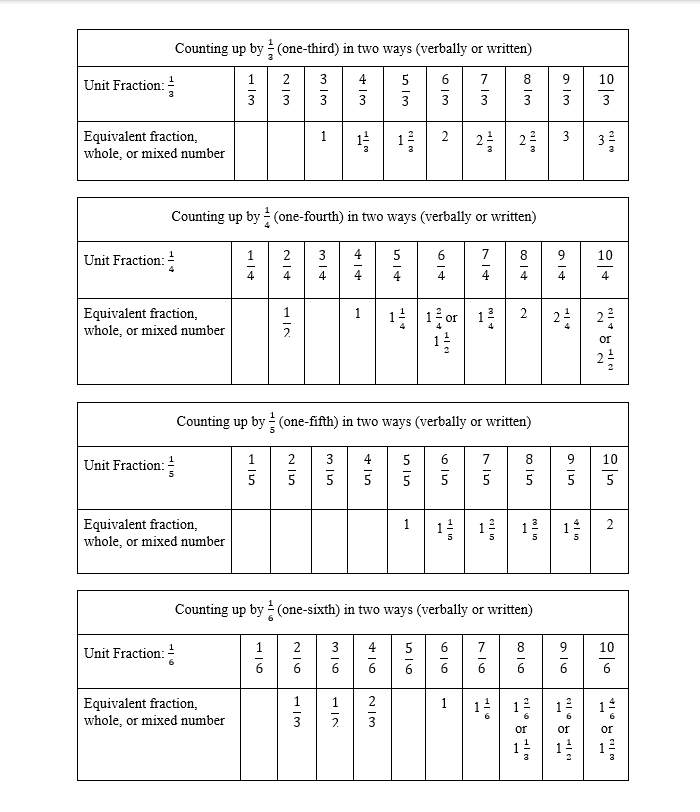
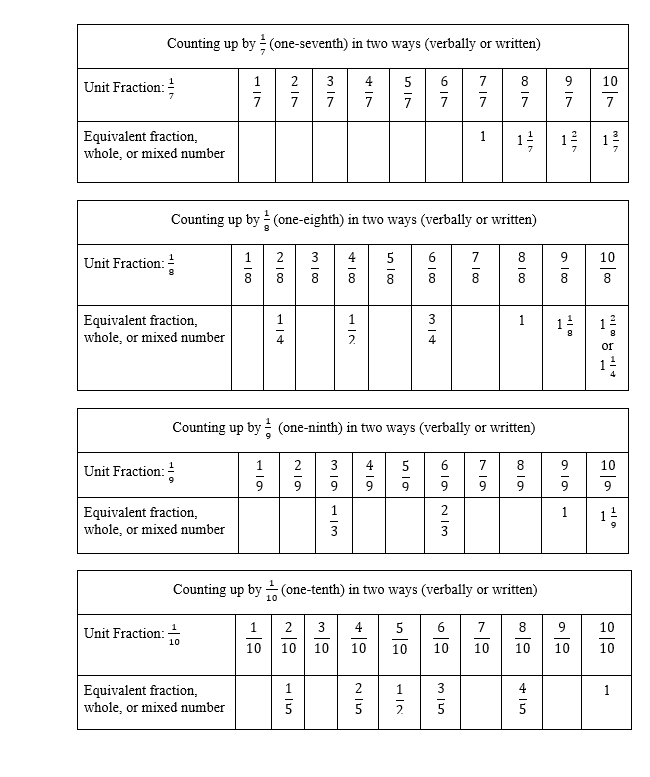
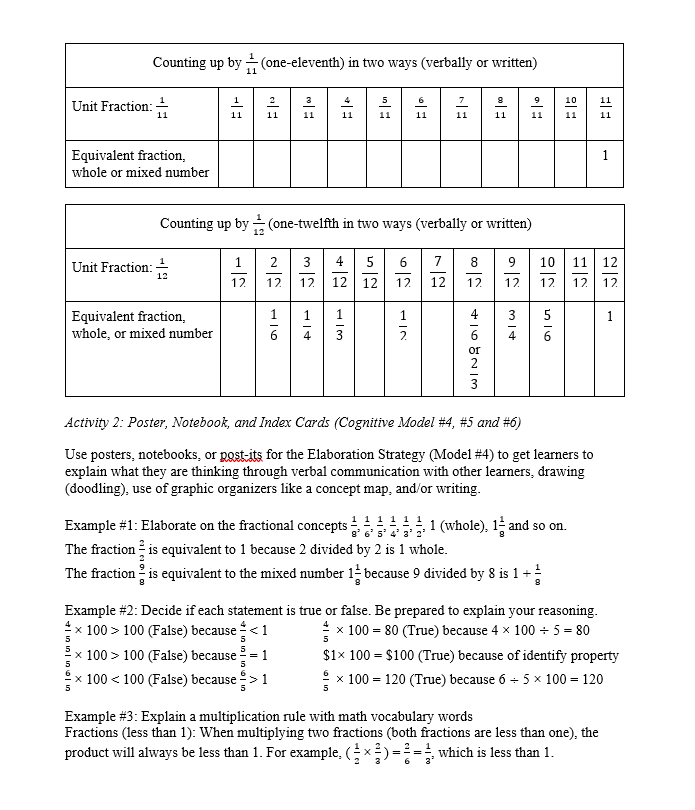
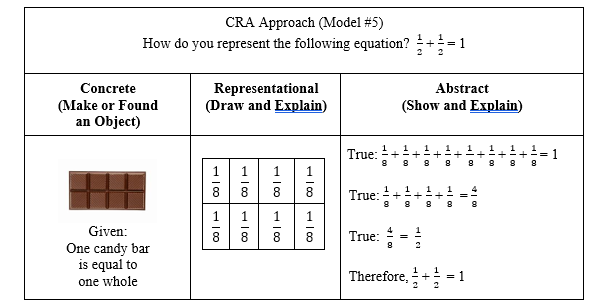
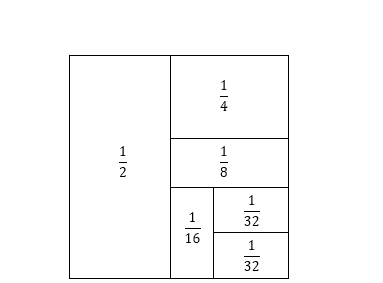
Activity 1: Morning, Afternoon, and Night (Cognitive Models #1, #2, #3 and #4) Skip counting is essential in recognition of number patterns, especially with unit fractions. Use spaced practice strategy (Model #1) in setting up daily practice opportunities for skip count unit fractions from (one-half) to (one-twelfth). Each session may take 5 to 10 minutes and it can be a warm up, cool down or homework worksheet. Suggestion: begin skip counting practice verbally once in the morning, verbally once in the afternoon, and written once for homework. Use interleaved practice (Model #2) to alternate which unit fractions to skip count daily. Once students are comfortable with counting unit fraction using additive reasoning with fractions and fractions greater than one ( , , , and so on), then alternate the sequence with fractions, whole number, and mixed number ( , 1, 1, and so on). Another practice activity is plotting points on a number line. Use grid paper or lined paper to create equal partitions of unit fractions to aim for precision and understanding the importance of scale in visual representation. Since scale refers to the relative size of an object in comparison to another object or a standard reference (e.g., 1 cm: 100 m), student understanding of this method of visual representation of unit fractions will build understanding of the fraction relationship to ratio, proportion, and percentage (a 6th grade and above Math Common Core Standard). Furthermore, plotting unit fractions of different magnitudes on number lines will reveal how one whole is a different length depending on the magnitude of the unit fraction. For example, 3 equal partitions of using a grid paper is equivalent to 10 equal partitions of because both represent one whole, even though 10 partitions are longer in distance than 3 partitions. In real-life application, engineers and architects tend to draw objects in scale to create precise representation and calculations, while graphic designers and artists may use a distorted scale to achieve the desired visual effects and/or emotional impacts with exaggerated proportions. To master skip counting the following lists of unit fractions may take students a month to 12 weeks depending on their prior understanding and rate of growth in fraction understanding. Important: Ask students to look for fractional patterns for each unit fraction, and use Elaboration Strategy (Model #4) to make sense of thinking. Also, I’ve made a practice quiz on the popular online game Blooket as an example of retrieval practice (Model #3). See https://dashboard.blooket.com/edit?id=68447c5060ba227d20bc47fc My account handle is: lyau24 and I will continue to add more fraction quizzes for spaced, interleaved, and retrieval practices. Example #4: Explain a multiplication rule with math vocabulary Fractions greater than 1: If one or both fractions are greater than 1, the product will be greater than 1, less than 1, OR equal to 1. For example, ( × ) = = 2 (greater than 1), ( × ) = = 1, ( × ) = (less than 1). For the CRA Approach (Model #5), use a three-column chart or other graphic organizers to have students to represent a fraction understanding. See example below. When using the CRA Approach, remember to also take note of the DCT (Model #6) to represent information in two distinct ways: language-based (verbal in terms of speaking and writing) and image-based (non-verbal in terms of pictures and actions) as well as the Elaboration Strategy (Model #4). One activity is to have students use index cards to generate images on one side and writing on the other side. Use these index cards with dual coding as flashcards for studying, matching, acting out, and verbally elaborating each depicted fraction concepts or problems. Activity #3: Music, Movement, and Mediation (Model #7) Below is a short list of suggested YouTube videos to give students a brain-break to reduce the cognitive overload of information about fractions. Fractions & Fitness – LEVEL: EASY for 3rd – 6th Graders (w/audio) Fraction Song- My Dog Fraction Adding & Subtracting Fractions Song: LIKE and UNLIKE Denominators Fractions Music Video – Washington School – CUSD 200 Fractions Song (To “APT” by ROSÉ & Bruno Mars) Playing Fraction Pies (part 1 of 3) – Connecting Music Notes and Pie Fractions Activity #4: Project-Based Design (Model #8) Lesson #1: Activate prior knowledge by showing 5-minute of a video about bird flocking as students record their observations with the “I Notice/Wonder” instructional routine. Discuss and share observations: Why Do Starlings Flock in Murmuration? Additional videos if needed: How Single Dogs Can Herd Giant Groups of Sheep How do schools of fish swim in harmony? – Nathan S. Jacobs Inside the ant colony – Deborah M. Gordon Harvard Unleashes Swarm of Robots Swarms of robotic fish can synchronize their swimming, for the first time Lesson #2: Introduce the term “Swarm Intelligence” to explain how the science of starling murmuration. Use the “Act It Out” routine to demonstrate the three basic rules of flocking: Separation, Alignment, and Cohesion (See Teaching Strategies under SI). Solicit volunteers or have the whole class to use the “Act It Out” routine to create an improvised dance or group walk. Afterwards, discuss if humans have swarm intelligence. If no, ask why not? If yes, ask how? Below is a short list of instructional videos to demonstrate different ways of creating human flocking through dance. Dance Improvisation – Flocking, and Lesson #3: Introduce the project-based learning challenge to create a mosaic, a universal flag, or a community garden using swarm intelligence. Students will discuss how to honor three simple rules of swarm behaviors: 1) Sharing Leadership and Design: Each student (or classroom) could develop their design ideas and insights, which are then shared within the group where any student can take the lead at any time.56 2) Wing-mate Solidarity: Students support each other and ensure no one is left behind, mirroring the solidarity of starlings staying together to avoid predators.57 3) Action-Feedback-Change Loops: Students react and adapt based on feedback from their peers, creating continuous learning and triggering a wave of hardly noticeable improvements that have the potential to solve complex problems.58 Below is a more kid-friendly wording of the three rules of behaviors: Decide on a few math parameters for the design with students: End goal of the project-based design: The overall mosaic design includes works of all students and each unit fraction can move to a new location after a Action-Feedback-Change loop (rule #3). The resulting patterns may represent the dynamics of a crowd thinking, or the formation of a complex structure. Optional: If the class agrees, viewers can interact with the mosaic by triggering changes in the placement of each unit fraction in real-time. Allow students about two to three weeks to consolidate all of their designs into one overall design. Explain and remind the class about the concept of stigmergy, an indirect coordination of actions where the trace left in the environment by a free agent (student) stimulates a succession of actions from the same or different agent (another student) or group. 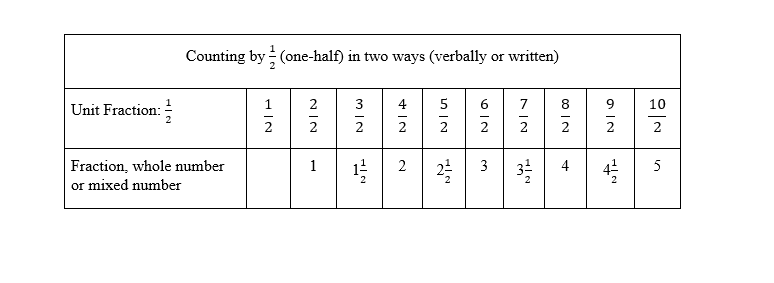
Annotated Bibliography Afolabi, Adedayo Olatunde. “Mathematics Learning through the Lens of Neuroplasticity: A Researcher’s Perspective.” International Journal of Research and Innovation in Social Science VIII, no. IIIS (2024): 4150–58. https://doi.org/10.47772/ijriss.2024.803299s. Accessed June 22, 2025. This paper combines major findings in neuroplasticity research to debunk the myth that mathematical ability is “fixed.” Autin, Gwen H. “The artist teacher uses proportion; the math teacher helps students understand the how and why, fractions fly the kites.” Journal for Learning through the Arts 3, no. 1 (2007). This paper describes how a math teacher and an artist co-presented to a group of 4th graders with Chinese kite project-based learning based on the fraction understanding. Bailey, Drew H, Robert S Siegler, and David C Geary. “Early Predictors of Middle School Fraction Knowledge – PMC.” Developmental Science 17, no. 5 (n.d.). https://doi.org/10.1111/desc.12155. This article examines how early understanding of fractions is a good indicator of later math achievement based on longitudinal studies. Barbieri, Christina A., Jessica Rodrigues, Nancy Dyson, and Nancy C. Jordan. “Improving fraction understanding in sixth graders with mathematics difficulties: Effects of a number line approach combined with cognitive learning strategies.” Journal of Educational Psychology 112, no. 3 (2020): 628. This article details the success of a math fraction intervention (27 lessons) using the number line and the science of learning principles. Brown, Peter C., Henry L. Roediger III, and Mark A. McDaniel. Make It Stick: The Science of Successful Learning. Harvard University Press, 2014. This book explains how cognitive models like spaced and interleaved practices are proven to be more effective than study habits like underlining, highlighting, rereading, cramming, and single-minded repetition of new skills. https://www.hup.harvard.edu/file/feeds/PDF/9780674729018_sample.pdf Chen, Yuxing. “Swarm Intelligence in Architectural Design — Yuxing Chen.” Accessed June 22, 2025. https://www.yuxingc.com/flocking-incubator. A website of the architect Chen with videos, photos and drawings of their design projects that use the concept of swarm intelligence to improve efficiency from scale of an ant to scale of a city. Clearwater, Liberty. “Understanding the science behind learning retention.” (n.d.). Indegene. https://resources.indegene.com/indegene/pdf/articles/understanding-the-science-behind-learning-retention.pdf Accessed June 20, 2025. This article explains the science behind learning, more specific topics include: the Forgetting Curve, Knowledge Pyramid, Cognitive Load Theory with graphs and diagrams. In addition, the article suggests ways to apply these theories to practical applications like retention strategies. Culatta, Richard, “Elaboration Theory (Charles Reigeluth),” in Instructinaldesign.com. (n.d.). https://www.instructionaldesign.org/theories/elaboration-theory/#google_vignette. Accessed June 22, 2025. This article explains the Elaboration Theory with a listing of its application and principles. Dehaene, Stanislas. The Number Sense: How the Mind Creates Mathematics, Revised and Updated Edition. OUP USA, 2011. The book explores how mathematical abilities have been learned and numbers are encoded by single neurons, and which area of the brain activates when we perform calculation. Dotan, Dror, and Sharon Zviran-Ginat. “Elementary Math in Elementary School: The Effect of Interference on Learning the Multiplication Table.” Cognitive Research: Principles and Implications 7, no. 1 (Dec. 2, 2022): 1–17. https://doi.org/10.1186/s41235-022-00451-0. Jarrett, Neil. “Swarming the Classroom,” in EDTECH 4 BEGINNERS. March 21, 2018. https://edtech4beginners.com/2018/03/22/swarming-the-classroom/. This article details how swarming can be used in the classroom. Kee, Jessica Baker, Cayla Bailey, Shabreia Horton, Katrice Kelly, James McClue, and Lionell Thomas. 2016. “Art at Ashé: Collaboration as Creative Assemblage.” Art Education 69 (5): 14–19. https://www.tandfonline.com/doi/full/10.1080/00043125.2016.1201408 A group of 24 students (grades K to 12th) was each given a suitcase to create a mixed media artwork to represent their personal, family, and community identities. Lovett, Marsha C., and Joel B. Greenhouse. “Applying cognitive theory to statistics instruction.” The American Statistician 54, no. 3 (2000): 196-206. Accessed June 22, 2025. https://www.researchgate.net/publication/245455039_Applying_cognitive_theory_to_statistics. Proposes 5 main principles of effective cognitive learning. Niche.com. “Francis Scott Key School.” Accessed March 18, 2025. https://www.niche.com/k12/francis-scott-key-school-philadelphia-pa/students/ Obersteiner, Andreas, Thomas Dresler, Silke M. Bieck, and Korbinian Moeller. “Understanding fractions: Integrating results from mathematics education, cognitive psychology, and neuroscience.” Constructing number: Merging perspectives from psychology and mathematics education (2019): 135-162. Polk, Thad A., Introduction to Cognitive Science. The Great Source, 2024. This book has 24 lectures by the author addressing some of the most challenging questions in cognitive science today: How do humans process language? How do we make decisions, and why do we so often regret them later? Rolling, James Haywood. “Swarm Intelligence: What Nature Teaches Us About Shaping Creative Leadership.” Macmillan + ORM, November 26, 2013. A book about swarm intelligence. The author argues that school focuses too heavily on rote learning and test-taking, leading to children being cut off from their natural impulses and restricting their creativity in a trap of low expectations. Rosenberg, Louis B. “Human Swarming IEEE Blended Intelligence,” 2015. YouTube Video (25 minutes) https://www.youtube.com/watch?v=2yAkFTimnqI&t=717s Accessed June 22, 2025. This YouTube video documents Professor Rosenberg’s lecture with slides on the topic of human swarming and intelligence. Rosenberg, Louis B. “Human Swarms, a real-time method for collective intelligence.” Proceedings of the European Conference on Artificial Life, 2015, pp. 658-659. This article gives examples of research that supports how human swarming yields more satisfactory decisions than votes or polls. Rosenberg, Louis B. “Human Swarming and the Future of Collective Intelligence,” Singularity Weblog. July 20, 2015. Accessed June 27, 2025. https://www.singularityweblog.com/human-swarming-and-the-future-of-collective-intelligence. The author describes several projects related to human swarming and posts many questions about its future. Salimi, Mahsoo. Swarm Systems in Art and Architecture: State of the Art. Springer Nature, 2021. This book presents the recent computational developments inspired by swarm art and analyzes 120 swarm systems that can be inspired future projects by artists, architects, and computer scientists. Schwartz, Sarah. “Making Sense of Fractions: This Tactic Helped Students Grasp a Key Math Topic,” Education Week. September 26, 2023. This article discusses the specific approach of using a number line (as opposed to parts of a whole shading method) that helped students better understand fractions. Stafylidou, Stamatia and Stella Vosniadou. “The Development of Students’ Understanding of the Numerical Value of Fractions.” Learning and Instruction 14, no. 5 (n.d.): 503–18. 2004. https://doi.org/10.1016/j.learninstruc.2004.06.015. Accessed June 22, 2025. This article explains an experiment on the development of fractions understanding with 200 students ranging in age from 10 to 16 years. The findings show understanding the relationship between the numerator and denominator improve the skill of ordering fractions of different magnitude. Tian, Jing, and Robert S. Siegler. “Fractions learning in children with mathematics difficulties.” Journal of Learning Disabilities, 50, no. 6 (2017): 614-620. Accessed June 22, 2025. https://journals.sagepub.com/doi/abs/10.1177/0022219416662032. This article examines the learning difficulties of fractions exhibited by students in the United States in comparison to students in China, and concludes that the development of fraction magnitude knowledge and several interventions using the number lines can improve fraction understanding. U.S. News Education. “Key Francis Scott School.” Accessed March 18, 2025. https://www.usnews.com/education/k12/pennsylvania/key-francis-scott-school-236825. Weinstein, Yana, Christopher R. Madan, and Megan A. Sumeracki. “Teaching the Science of Learning.” Cognitive Research: Principles and Implications 3, no. 1 (2018): 1-17. https://doi.org/10.1186/s41235-017-0087-y. Accessed March 22, 2025. This tutorial review focuses on six specific cognitive strategies: spaced practice, interleaving, retrieval practice, elaboration, concrete examples, and dual coding with descriptions of research findings, illustrations, implementation in classrooms, and recommendations in education. Wilkerson, Trena L., Susan Cooper, Dittika Gupta, Mark Montgomery, Sara Mechell, Kristin Arterbury, Sherrie Moore, Betty Ruth Baker, and Pat T. Sharp. “An investigation of fraction models in early elementary grades: A mixed-methods approach.” Journal of Research in Childhood Education 29, no. 1 (2015): 1-25. This study (a sample of 54 kindergartners and 3rd graders) examines the effects of two different models (discrete and continuous) on student understanding of fractions. Young Z, La HM. “Consensus, cooperative learning, and flocking for multi-agent predator avoidance.” International Journal of Advanced Robotic Systems. 2020;17(5). doi:10.1177/1729881420960342. Accessed June 22, 2025. This article explains how birds internalize a hybrid multiagent system that integrates consensus, cooperative learning, and flocking to determine the flying direction of predators. Zeitoun, Lea. “DRIFT Explores Power of Choice with ‘Murmuring Minds’ at LUMA Arles.” Designboom. September 29, 2024. Accessed June 22, 2025. https://www.designboom.com/art/drift-choice-swarm-inspired-murmuring-minds-luma-arles-09-05-2024/. . Endnote https://edtech4beginners.com/2018/03/22/swarming-the-classroom/ Accessed June 22, 2025. https://www.youtube.com/watch?v=2yAkFTimnqI&t=717s. Accessed June 22, 2025. https://doi.org/10.1186/s41235-017-0087-y. Accessed June 22, 2025. https://resources.indegene.com/indegene/pdf/articles/understanding-the-science-behind-learning-retention.pdf. Accessed June 22, 2025.
This Math curriculum unit on fractions aligns the following two 5th grade Math Common Core State Standards (5.NF.B.4 and 5.NF.6): 5.NF.B.4: Apply and extend previous understandings of multiplication to multiply a fraction or whole number by a fraction. 5.NF.B.4.a: Interpret the product (a/b) × q as a part of a partition of q into b equal parts; equivalently, as the result of a sequence of operations a × q ÷ b. For example, use a visual fraction model to show (2/3) × 4 = 8/3, and create a story context for this equation. Do the same with (2/3) × (4/5) = 8/15. (In general, (a/b) × (c/d) = (ac)/(bd). 5.NF.B.4.b: Find the area of a rectangle with fractional side lengths by tiling it with unit squares of the appropriate unit fraction side lengths, and show that the area is the same as would be found by multiplying the side lengths. Multiply fractional side lengths to find areas of rectangles, and represent fraction products as rectangular areas. 5.NF.B.6: Solve real-world problems involving multiplication of fractions and mixed numbers, e.g., by using visual fraction models or equations to represent the problem.