Rationale
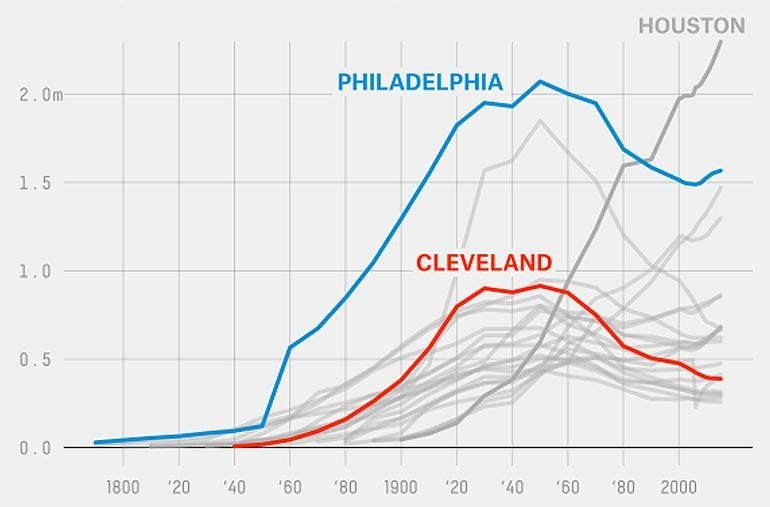
My intention with this curriculum project is to increase student engagement and critical thinking skills by encouraging students to make sense of real-world phenomena. Students will be asked to analyze population data, graph the data, and draw conclusions about changes in population based on numerical and historical evidence. Students will also be asked to estimate projections of population increases or decreases based on current trends. For example, teachers can provide students with raw population data and ask them to predict a percent increase or decrease in Philadelphia’s population in 2021. Students will support their conclusions with data and explain factors they believe are causing the change. The social studies teacher will provide context and make connections to prior historical events while the math teacher will provide the tools for understanding numerical data, creating graphs, or making calculations. Fusing math and social studies, lessons should enhance students’ understanding of historical facts, help them draw and defend conclusions, and explain their reasoning. Another advantage is that this fusion embeds the need to learn the mathematical skill in an authentic motivation: the desire to understand historical trends and patterns. The lesson plans below are a guide for middle school mathematics and social studies teachers to supplement existing curricula by visualizing historical data in new ways.
How will this be accomplished? Using the Common Core’s Standards of Mathematical Practice, which can be applied across content areas, students will extend mathematical thinking to a social studies setting. Students require repeated exposure to math content outside of the mathematics classroom in order to build connections and retain information. Teachers must offer students a variety of ways to visualize data using line graphs, pie charts, and models in different subject classes. Historical data tells a story, and students will be asked to write their own narrative of our city with help from both the math and social studies teachers. Students will investigate Census Bureau data in various forms and seek to answer essential questions posed by the teachers provided in the lesson plans below. Students are also encouraged to ask their own questions, hence the use of the Notice and Wonder activity which asks for 100% participation and engagement.
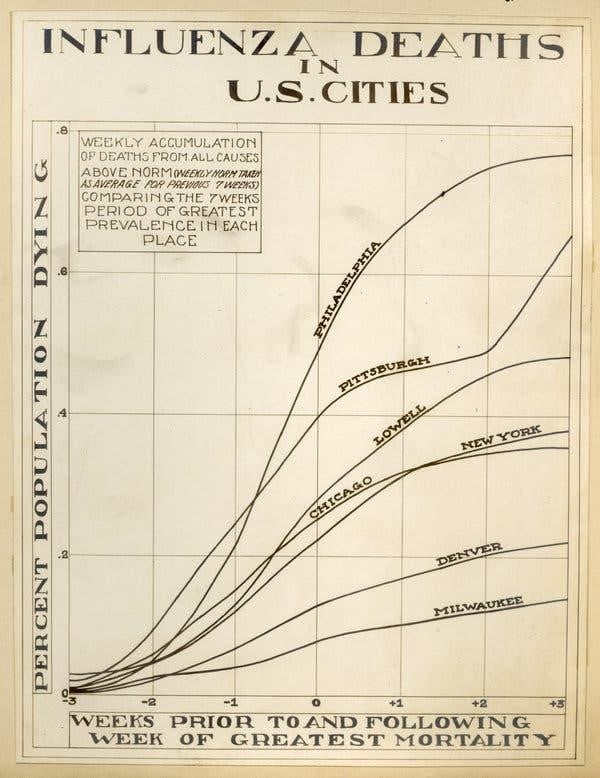
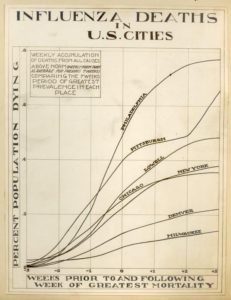
Students will have repeated exposure to applications of percentages in math class and will apply this learning to social studies concepts. For example, once students have learned how to find percent change in a math classroom, they can then analyze historical data line graphs–about population decline or wage increases, for example–in social studies class and make inferences about the impact and historical context. Teachers can ask students to read about population change and host a debate about most important causes. Some social studies standards, which are closely linked to ELA standards, that could be implemented in this interdisciplinary unit include: citing specific textual evidence to support analysis of primary and secondary sources (Ex.The population trend line keeps decreasing. What does the data in this graph suggest about the Spanish Influenza outbreak in American cities?); determining the central ideas or information of a primary or secondary source (Ex.What story is this graph telling?); providing an accurate summary of the source that may challenge your prior opinions (Ex. Use a graph to tell a story in your own words using data points along the graph. What surprises you about this graph? How does this graph change what you thought you knew about the subject before?); and integrating visual information in charts, graphs, and maps (Ex. Applying scale on a map, create a historical timeline and find the population change each decade). The new social studies curriculum incorporates many such activities and questions, but students may not have the mathematical skills to answer these questions in any depth. Coordination with math teachers will help in this area.
Studying population change in Philadelphia allows students to evaluate data and come up with their own sketch of city history based on the numbers. Factors that lead to population change that students can learn about include but are not limited to: natural changes such as births and deaths; domestic and international immigration; job growth and loss in manufacturing and commerce; the 1854 incorporation of neighborhoods into the official city borders and population; and changing ethnic composition.
My ultimate goal is to increase students’ mathematical capacities and help them see data in a new light. Some of the population graphs provided in the Appendix are rather complex, but students are able to grasp concepts within their zone of proximal development if they are challenged and provided appropriate scaffolding. Traditionally, a math teacher would teach a procedure and have students practice problem solving. We are now encouraging the Productive Struggle approach by being less helpful and encouraging risk taking. The Productive Struggle embodies the approach I am aiming to take- which is to start with a question, rather than a procedure or algorithm to follow, and empower students to use their problem solving skills and find a solution on their own. If you are new to the Productive Struggle, consider watching Dan Meyer’s “Math Class Needs a Makeover” TED Talk for more insight.
Background
I have been teaching ELA, Science and Mathematics in Title 1 schools for the past decade in North Philadelphia. These schools have underserved student populations with >90% living in poverty and receiving free or reduced-price lunch. These schools are stigmatized as “failing schools” based on their lack of Adequate Yearly Progress (AYP) on summative state assessments such as the PSSA and NAEP.
There is a litany of factors that contribute to the labels of “failing schools.” Some of these factors include, but are not limited to: large class sizes, inexperienced teachers, high teacher turnover rates, public school funding formulas, and excessive concern for testing. Math teachers are expected to “teach the test” and cover 45 standards in 36 weeks in 7th grade. This year I have transitioned to a role as a new teacher coach, in order to broaden my scope, learn new skills, and work in a variety of settings. In my role, I am finding that new math teachers tend to teach as they were taught: math is its own island, separate from other subjects, largely out of context or in hypothetical situations. What we are seeing in classrooms so far is the opposite of what the Common Core standards expect, hence my desire to reform how we teach mathematics.
Although memorizing your times tables is useful, mathematics that has been taught in underfunded public schools is frequently rote memorization of facts and formulas. These classrooms focus on using procedural fluency and skill practice, but often skip over the conceptual understanding that is desperately needed for all students, especially those who might be two or more grade levels behind, have learning differences, or who are learning English as a second (or third) language. As the current focus on procedural fluency is failing our urban, public school students, there will also be a greater focus on the application of the skills in this unit, such as predicting population changes through graphs or tables using real-world census data. By repeatedly exposing students to math concepts in other settings, they will be able to apply higher order thinking skills (Ex. analyzing data, synthesizing info. on multiple graphs).
Historical Context: What is a City?
Before diving into a brief overview of Philadelphia’s history, I think it is important to elucidate the concept of a city from our readings and lively class discussions during our course The City In History at Temple University led by Dr. Spodek. Throughout this seminar, ideas for how to incorporate mathematics lessons within this social studies topic became clear.
We began with readings about cities in Ancient Greece and Plato’s economic perspective on cities. He argued that a city, or polis, has an ideal size of about 5,000 citizens and is a place to exchange goods and daily necessities such as food and clothing. These exchanges lead to partnerships, specialization of crafts, and divisions of labor. He also argued that humans have many desires, such as exotic luxuries, but should stick to basic things such as caring for the body, mind and soul through gymnastics, art and music. When populations in Greek cities grew too large, younger residents were encouraged to found their own neighboring towns.
Aristotle built on Plato’s teachings with his notion of zoonpolitikon: man as a political animal. In other words, the city is where you live and learn to be a good statesman or citizen. He believed that only in the polis could a person grow intellectually, spiritually and morally. City fundamentals such as a sense of community and cooperation, individual rights, self-sufficiency and privacy were born. Greek cities were built using the same urban planning design–an acropolis at the summit for worship; the agora for public affairs and commerce; and then homes below.
How does this apply to mathematics? About 1 or 2 out of every 10 residents were able to participate in the Athenian Democracy. White land-owning men who completed military training had the right to vote; women, freed slaves, slaves, foreigners and children were all excluded from voting. The farmers toiling in the fields rarely came to the city to cast their votes. An essential question that can be posed to students would be “Was the Athenian democracy fair and just?” In this case the social studies teacher will present the historical aspects and context, and the math teacher can support students by finding percentages of eligible voters in Ancient Athens. To better visualize how many people are included in this type of democracy, students can imagine 20% of their class voting in an election for class president, with 80% left out. These percentages can then be graphed and compared to present-day percentages of eligible voters in Philadelphia or Athens to determine how democracy has changed and in what capacity it has continued from its inception. Ultimately students will ask their own questions and seek answers through critical thinking and apply math to help them make sense of historical phenomena. Without the mathematics component, students may not be able to fully grasp the concept and develop a strong answer to the essential question.
Consider another application of math in Ancient Greece. For example, in The Polis, British scholar H.D.F. Kitto describes the polis as a self-governing community. He states that the Spartans had “conquered and annexed Messenia, and possessed 3,200 square miles of territory.” (p.42) Population change becomes an important factor. A similar question can be asked, “To what extent was the polis a self-governing community?” The social studies teacher would introduce information about the demographics and population of the newly annexed area, and the math teacher would facilitate various calculations about percentages of residents who actually govern. This can be compared to calculations regarding Spartan governance before annexation or even compared to previous calculations about Athens in order to help students answer the guiding question.
Math connections in Ancient Greece need not stop at percentages to aid visualization and argumentation. Students could be asked to use mathematics to find the total new area of the Spartan territory in terms of square miles (or convert to kilometers), create a scale model of this territory (or of Greek cities) using ratios and proportions, or find the increase in population as percentages to the entire Spartan territory. With some scaffolding, the aforementioned readings are all accessible for a 7th grade reading level and could be read in a social studies classroom. The purpose of these activities is to enhance student understanding of the math functions and the implications and scope of historical events.
Not all writers were as optimistic as Plato and Aristotle about the city. John Lanchester argues in The Case Against Civilization that the interests of individuals are in conflict with the interests of the state. Lanchester claims that our reliance on crops such as grains and cereals have led to the development of cities, as we lack the variety of food sources afforded by our late neolithic ancestors. Yale political science professor James C. Scott is quoted several times in Lanchester’s article. He argues that grains could be easily taxed and were “visible, divisible, assessable, storable, transportable, and ‘rationable.’” Numerical record keeping was born as was the need for mathematics. Supply and demand also created a social hierarchy of the wealthy elite, special laborers, and led to the enslavement of free people for labor. Algebra was created to calculate unknown amounts of goods. With the introduction of money into the class discussion, students can also calculate unit rates, tax percentages, and begin to see wealth disparities of the rich and poor 4,000 years ago. Incorporating mathematics again allows for students to better comprehend day to day life of particular types of people and to empathize with the gaps between social classes.
In What is a City?, social critic and philosopher Lewis Mumford states:
“The city is a related collection of primary groups and purposive associations: The first, like family and neighborhood, are common to all communities, while the second are especially characteristic of city life. These varied groups support themselves through economic organizations that are likewise of a more or less corporate, or at least publicly regulated, character; and they are all housed in permanent structures within a relatively limited area. The essential physical means of a city’s existence are the fixed site, the durable shelter, the permanent facilities for assembly, interchange, and storage; the essential social means are the social division of labor, which serves not merely the economic life but the cultural processes. The city in its complete sense, then, is a geographic plexus, an economic organization, and institutional process, a theatre of social action, and an aesthetic symbol of collective unity….It is in the city, that man’s more purposive activities are focused, and work out, through conflicting and cooperating personalities, events, groups, into more significant culminations.” (p. 93)
Mumford describes the city and its groups partly in terms of mathematical functions where the size of a city determines the availability of social functions such as universities. He claims,
“What is more important is to express size always as a function of the social relationships to be served.” (p.93) This concept could be useful for teaching functions (inputs/outputs) in 8th grade. Teachers could have students identify factors that cause populations to change and determine a population’s effects on urban institutions such as transportation, tax revenue, pollution, etc.
To help prove my case for applying math concepts in a social studies setting, it is worth mentioning urbanization. In Urbanization of Human Population, demographics professor Kingsley Davis discusses the rates of change in population of cities, or “the proportion of total population concentrated in an urban settlement.” (p. 24) Urbanization as a function can be explained as an inversely proportional relationship: urban population increases when the rural population decreases; the rural population increases when the urban population decreases. If students are learning about factors that cause people to move to and from cities, then we can use mathematics to help quantify these push and pull factors by visualizing the data. This allows students to grasp complex relationships in context. Essential questions that could be asked include: How does modern urbanization affect economic growth? What are the effects of declining rural population/increasing urban population? How does a fluctuating population affect the cost of living in a city?
One of our sessions this semester focused on city residents who are not counted in the official census. These residents work in an informal economy and are frequently not officially recognized in government records and census data, generally do not pay taxes and lack equal rights and opportunities. It is estimated that 60% of the world’s population work in the informal economy (ILO, 2018). This begs several questions, which students can unpack in interdisciplinary social studies and math lessons: Who is in our cities? Who has representation and who does not? Of these visible and invisible populations, who lives where and controls what percentage of the wealth? Not only can these concepts be calculated, often through percentages, to bring more depth to the conversation, but they can also be mapped and graphed using mathematics lessons.
There are several organizations such as Women in Informal Employment: Globalizing and Organizing (WIEGO), the Self-Employed Women’s Association (SEWA), and Domestic Workers United that are advancing an equal rights movement to help provide secure employment for 53 million women around the world. These organizations have a manifesto that acts as an equitable conduit between local governments and the informal workers union. They argue that the urban designers do not take into account the needs of workers in the informal economy- such as access to health care, women’s shelters, sanitation, utilities, or open space. The need to recognize these workers is vital, as they lack social protections, and earn low wages. These organizations assist the informal economy as the workers deserve to be heard and recognized, have the opportunity to unionize, negotiate with their employers and government to improve their living conditions. For example, in Pune, India, waste management workers earned higher wages and the necessary protective gear with assistance from these non-governmental organizations (NGOs). Workers received fire safe equipment to protect them on the job in Accra, Ghana, and earned higher wages through the Homeworker Protection Act in Bangkok, Thailand. Urban designers and planners of the future must account for these residents. Using historical information about cities and data from these organizations, students can step into the role of urban planners, using social studies knowledge and math skills to propose solutions to many of these issues.
Another reading apropos of mathematics in urban design is Ebenezer Howard’s Garden Cities of Tomorrow from the turn of the 20th century. The article includes several diagrams that could introduce the concept of scale in finding distance on a map. A social studies teacher could teach about the differences and similarities of Howard’s town, country, and town-country concepts, while the math teacher helps students to determine distances and create their own scale models of cities using Howards’ Garden City design. Furthermore, given the pitfall of depth versus breadth in social studies classrooms, students often lack basic map skills by middle school, which teachers don’t feel they have time to teach. Creating interdisciplinary urban planning projects with a math teacher would benefit both content areas.
Currently in America there are enormous disparities between social groups across the nation and within cities. A New York Times opinion series titled The America We Need calls for economic security and equity of opportunity for historically marginalized groups such as people of color. We are suffering from both racial and economic segregation in our cities caused by systemic and institutionalized racism. According to the article, “Over the past decade, the wealth of the top 1 percent of households has surpassed the combined wealth of the bottom 80%.” (April, 2020) Contributing to this incredible disparity of wealth are successful campaigns of the wealthy blocking social changes such as unionization; these kinds of campaigns date back to the Black Plague in the 1340s! Impoverished neighborhoods were included in city designs, such as Ernest Burgess’ concentric zone model and his premise of ‘social ecology’ that designate social groups such as African Americans, women and immigrants, and clump various ethnic groups with stigmatizing terms such as ‘ghetto’, ‘slum’, ‘underworld,’ ‘Little Sicily’ and ‘Chinatown.’” Burgess poses a great essential question that could be used by either the social studies or math teacher: “What is the significant aspect of movement for the study of the changes in city life?” (p.167) The chance to rise and climb among social groups is in serious decline: a staggering statistic shows the reality of the glass ceiling in America. Middle school students know that injustice exists, but often lack the language to describe this beyond “it isn’t fair.” Even the aforementioned examples of wealth disparity and disproportionate death rates will seem unfair to students, but they cannot truly grasp the injustice until they understand the math behind the examples.
Up until now we have spoken mostly about contributions from white men. It is imperative to highlight contributions of others who are too often underrepresented. Civil rights leader and renaissance man, W.E.B. Du Bois, wrote about the disparities between African American communities that were segregated due to racial prejudice. His time in Philadelphia at the turn of the 20th century in the downtown Seventh Ward district described the lives of African American homeowners, businesses owners and craftspeople. An Essential Question that can be asked to students from his work The Philadelphia Negro is “What is the real condition of this group of human beings? Of whom is it composed, what sub-groups and classes exist?” (p.111) Creating a graph or pie chart of this data will help students grasp nuances within or the disparities between social groups. He mentions taking into consideration the physical and environmental factors of a city. A visit to the present-day Seventh Ward in Philadelphia is a great opportunity for a field trip.
One application of mathematics in Du Bois’ writing describes the increase in population in the Seventh Ward: 3,621 in 1860; 4,616 in 1870; and 8,861 in 1890. (p.111) This is an opportunity to apply percent change to understand the increase in population in this neighborhood. Essential Questions could focus on which factors led to this increase in population as well as the social implications of the increase. With over one hundred years of gentrification, the Seventh Ward neighborhood today is part of the ritzy downtown area (Washington Square West), which is demographically different today than Du Bois’ depiction and account of racial prejudice. (Factors contributing to this gentrification include redlining: a prejudicial practice of segregating residents by race and blocking residents of color from owning a home in certain neighborhoods or obtaining a mortgage at a fair interest rate. The disparity of mortgage interest rates could be studied mathematically.) His article provides raw population data for residents of the Seventh Ward, and students can calculate percentages using his data as a primary source. The notion of an opportunity gap is evident during his time in Philadelphia, and still rings true today. Creating a mathematical visual of this opportunity gap using a map of the Seventh Ward would be a powerful learning tool. Du Bois adds that “most white people are quite unconscious of any such powerful and vindictive feeling.” (p.113)
Du Bois summarizes the racial segregation as follows: “Presumably the first impulse of the average Philadelphian would be emphatically to deny any such marked and blighting discrimination as the above against a group of citizens in this metropolis. Everyone knows that in the past color prejudice in the city was deep and passionate; living men can remember when a Negro could not sit in a street car or walk many streets in peace.” (p.114) There is a middle school appropriate movie on this subject. Although it took place some time later, the movie In the Heat of the Night featuring Sidney Poitier describes the illegal incarceration of an African American police officer from Philadelphia wrongly accused of a crime at a train station. This theme leads to another essential question: “What has changed, and what has remained the same since 1899 in Philadelphia for people of color?” Mathematics can be applied in this case to examine wage disparity between whites and Black residents of Philadelphia, and can be compared to present-day wage disparities between the binary genders. Similarly, rates of wrongly incarcerated people from Philadelphia could be calculated and tracked over years, as well as compared to rates of other racial groups.
Another important aspect of population changes in American cities relates to immigration. As the industrial American city emerged with the advent of industrial machines in the 1920s, the reduced need for immigrant labor caused restrictive immigration laws and a population reduction worth examining through a mathematical lens. Influxes of immigration caused by the Irish Potato famine, for example, in the 1840s and its effects can be studied in context. As Sam Bass Warner mentioned in Evolution and Transformation: The American Industrial Metropolis, 1840-1940, cotton textile workers in Philadelphia began to unionize to fight for higher wages and better working conditions thanks to the Clayton Anti-Trust Act in 1914. Warner claims that the state police was established to quell union strikes and mob uprisings. Ideally students themselves will be able to recognize that the implementation of rail lines in the 1850s led to an increase in jobs and population but also were a contributing factor to a rural population shift 100 years later. Social classes were already well established in the city- the wealthy, free African Americans and the poor, mostly comprised of new immigrants. Finally, an essential question from this topic could be: “When does everyone get the right to vote?”
Many of our readings focused on Western cities. One article that was rather interesting about urbanization in East Asia was the article Chinese Cities in a Global Society, written by scholar Tingwei Zhang. The author discusses reforms and factors causing a large population influx, which is important as about 20% of the world population live in China. Middle school students can easily grasp the concept of ‘1 out of 5’ people, but what does that mean in an urban context? Hopefully students will be able to explain some of the implications of having the world’s largest population and 2nd largest economy.
Peter Calthorpe’s speech, Seven Principles for Building Better Cities, plans for sustainable cities in the future focusing on walking, biking, and rapid mass transit systems. His recommendation is to match urban density and transit capacity in order to reduce traffic and pollution. Calthorpe argues that urban sprawl isolates people and segregates them into economic enclaves that are largely separated from nature. With half of the world’s populations living in cities, the estimated population in 2050 will increase by 2.5 billion people. Calthorpe poses a powerful question- “if 1/3 of the world’s population has cars, why do they get 70% of the street?” Calthorpe provides an ideal futuristic city- one that uses rapid transit buses and trams to reduce congestion and pollution, satisfies housing demands with mixed use buildings and community neighborhoods while also making cities green, walkable places. Combining mathematics and social studies lessons, middle school students too can comprehend this vision for the future.
Philadelphia Past and Present
Philadelphia, also known as the “Athens of America,” is a metropolitan city situated in Southeastern Pennsylvania, situated between the Delaware and Schuylkill Rivers with an official population of two million residents. The following is a brief overview of events in Philadelphia’s history, which either caused the population to increase or decrease significantly.
Before being settled in the 17th century by Europeans, the land where Philadelphia now stands was inhabited by Native American tribes, notably Leni-Lenape, Shawnee and Algonquian. The city itself was founded in 1682 by William Penn and in the 1690s had a population of about 600 people. Penn planned the city layout on a grid that included public squares, a town square, and housing layouts. Due to Penn’s urban planning design, the city expanded quickly and grew to a few thousand residents in the early 1700s. Residents were largely Quakers from England who sought freedom from religious persecution. German, Irish and Scottish immigrants arrived and the city continued to grow. There were several incorporations of neighborhoods (in 1701 for example), which allowed the population of the city (and the tax base) to increase. The port of Philadelphia on the Delaware River soon allowed the city to become an industrial center for trading and manufacturing leading up to the American Revolution.
Philadelphia was America’s first World Heritage City, valued by UNESCO for its contributions to world history. Some notable events that took place in Philadelphia were the first public school (1689), Pennsylvania’s first newspaper (1719), the first volunteer fire company (1736), first hospital (1755), the first Continental Congress (1774), and the first American flag (1777) created by Betsy Ross. Philadelphia also hosted the Centennial World Fair in 1876, and is known for creating the “row home” which made housing for industry workers affordable and established new neighborhoods in the city. The row home was in stark contrast to the large tenements in the working-class neighborhoods of Manchester, England as described by Freidrich Engles in The Great Towns. Philadelphia is also home to American landmarks such as the Liberty Bell. The Declaration of Independence and the United States Constitution were both drafted at Independence Hall. George Washington, the first President of the United States, lived here while Philadelphia served as the national capital, 1790-1800.
One significant event that negatively affected Philadelphia’s population was the Yellow Fever outbreak of 1793. Historians believe that the fever initially arrived at the shipping port docks, brought to Philadelphia on the ships owned by Stephen Girard from the Caribbean island of St. Domingue (Present day Hispaniola island of Haiti and the Dominican Republic). Another theory is that the outbreak was caused due to outhouse wells and sewers contaminating the local creeks. From the port and Olde City, the virus spread and killed approximately 10% of the population.
Some good did come from this tragic epidemic, however. Ben Latrobe and Frederick Graff established a municipal water system, now known as the Water Works in the Fairmount neighborhood. This water system provided clean drinking water to Olde City using gravity and slope, other concepts that students can explore in 8th grade mathematics. A possible reading from this event for students is “A narrative of the proceedings of the black people, during the late awful calamity in Philadelphia, in the year 1793: and a refutation of some censures thrown upon them in some late publications,” written by Absalom Jones and Richard Allen. Their account describes the heroic roles of African American men and women nurses who treated the predominantly white sick residents of the city, led by Dr. Benjamin Rush. Sam Katz, a local businessman and filmmaker created a documentary film series on Philadelphia. One of these films, titled Yellow Fever, could be used to supplement the reading. The image below is a primary source from 100 years ago that students can use to complete a Notice and Wonder activity.
Sample Notice and Wonder image using the “Influenza Deaths In U.S. Cities” graph
Source: NY Times
Later epidemics followed. By the 1800s Philadelphia was in the midst of the industrial revolution. Manufacturing and textile industries bolstered the economy and the city developed a strong economy. This led to the development of neighborhoods and to the birth of the row home. Other influxes of immigrants caused the population to increase, such as the Irish Potato famine in the 1840s. In the late 1800s, Chinese immigrants arrived, and the city continued to grow and diversify. The Spanish Influenza of 1918 struck Philadelphia fiercely as about 500,000 citizens contracted the flu over the next year, with over 15,000 deaths total; 12,000 died in just three months, September to November 1918 (Encyclopedia of Greater Philadelphia). Due to similarities with COVID-19, this might be a topic worth exploring with students and allowing them to compare and contrast the two events.
Population was influenced not only by diseases. Other notable population events include a steady influx of residents in the early 1900s. By the 1950s, when factory jobs dried up, several societal changes took place that caused a mass exodus of citizens in major cities. Women gained economic independence through national policies such as the Equal Pay Act of 1963, Title IX, Equal Credit Opportunity Act, and the Roe v Wade ruling. Women now controlled both their fertility and their vote. Birth control became legal, and gender roles changed as women increasingly joined the workforce.
As urban planner Daphne Spain mentioned in “What Happened to Gender Relations on the Way from Chicago to Los Angeles,” the urban space in American cities transformed from a modernist monocentric to postmodern polycentric metropolis. A boom of edge cities and new construction began. Families now needed two cars to get to work, and the Regional Rail train network was created for fast access to the city from suburbs on the “Main Line” in Ardmore and Bryn Mawr, about 10 miles away. Prior to 1940, fewer than 25% of women were in the workforce. In contrast, by 2001 more than 60% of all women were employed.
Spain also mentions important concepts worth discussing with students: that women went from unpaid to underpaid. To bring these gender disparities to light, students can learn about the Gender Wage Gap in social studies and apply math to determine how much money men earn on average compared to women. In a social studies classroom, data could be presented online graphs or bar diagrams that enable students to use percentages to make meaning from demographic information about race and gender disparities.
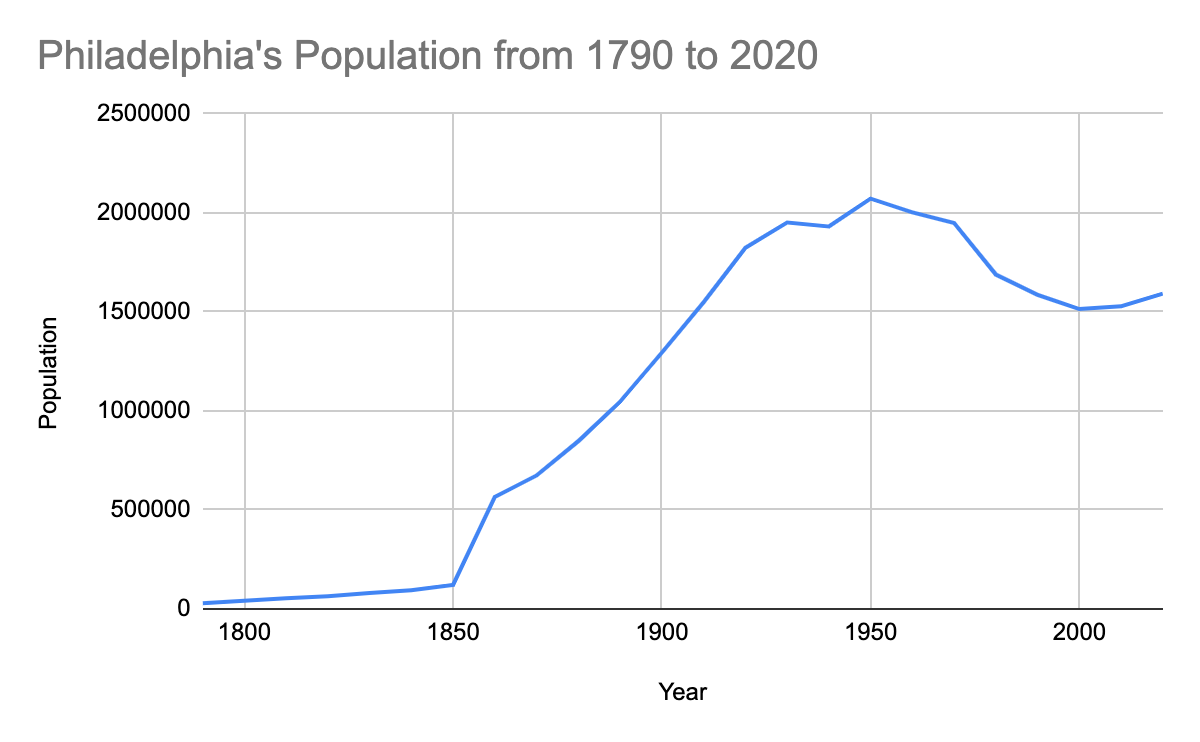
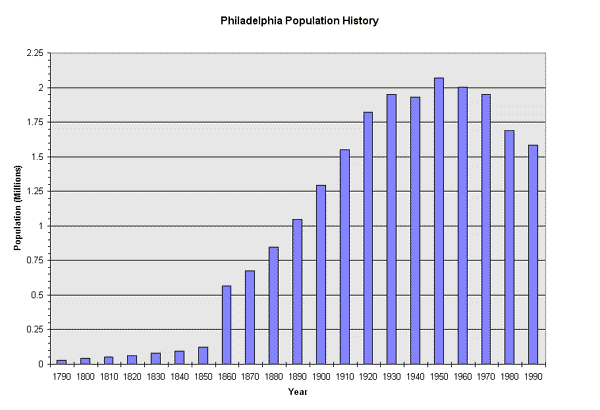
A 25% population decrease occurred over a period of 50 years from the 1950s-2000s. The population of Philadelphia fell from about 2 million inhabitants to about 1.5 million and family sizes shrank from about five children per household down to two. Although these are large numbers, a bar diagram can be shown to students so they can estimate the population change without using a calculator. We would like students to be less reliant on calculators and recommend the use of a bar diagram using 2 million as the whole (100%) population. Ideally students will explain that one quarter, or half of half, of the population left the city. There is a litany of essential questions that can be asked that have ramifications on the city noted in the lessons below.
Over the past 10 years, the city of Philadelphia has again seen a small increase in population with the help of tax-abatements for new construction and immigration. Certain communities are growing faster than others, and the demographics and ethnicities of the city continue to change. Philadelphia’s demographic breakdown is as follows: 44% African American, 36% Caucasian, 13% Latinx, and 7% Asian (US Census Bureau). Although the city appears to be diverse, it is a city largely segregated by neighborhoods. This is partially due to the ‘redlining’ tactic that occurred by denying services and mortgages to people of color in order to keep the neighborhoods segregated. A tool that could be used in the interdisciplinary classroom to study Philadelphia’s segregation is the citywide diversity index from the American Communities Project (ACP). Students can explore US Census Bureau data from the ACP and use census data to guide their understanding of urban diversity and segregation.
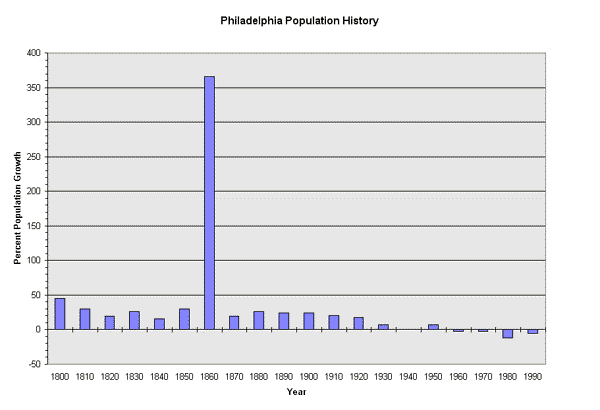
There is a plethora of resources below that can be used to find percent change in the form of graphs, images, charts, and visuals. The US Census Bureau has a wealth of raw data that has been visualized and is ready to use for Notice and Wonder activities. Ideally students will be able to have “voice and choice” with their assignments, hence the variety of resources for them to choose from. It is recommended teachers investigate the sources themselves prior to assigning them to students.
Problem Statement: Middle school 7th and 8th grade students are learning mathematics out of context with little connection to the real world. Mathematics is frequently taught in isolation from other subjects without connections or real-world applications. How can we apply mathematical concepts such as Notice and Wonder strategies to social studies lessons to deepen student’s understanding of both content areas?
Objectives
The learning objectives for the unit will be:
- To examine a graph in order to determine population percent change
- To understand and solve percent change problems
- To analyze graphs to make sense of data and make inferences about social studies
- To create context for mathematics in real-world settings
- To model and interpret social phenomena using mathematical models
Goals
- Increase mathematics achievement and proficiency on summative assessments for students in an urban setting
- Apply concepts of 21st century education in real world settings
Essential Questions
There are innumerable questions to be asked, even about population statistics. However, as a starting point, understand that the essential questions seek to deepen the meaning of lessons by uniting concepts and skills under a broader understanding thus allowing for students to see the ways in which smaller ideas synthesize into universal concepts. These questions may be posed in the beginning of a lesson for thought as students learn, to assess their grapes of a lesson as an Exit Ticket, or as a springboard for further questions and discussion. This list of questions is not by any means exhaustive. For some questions, further discussion grows from branching out, as seen by the particular way the research can be approached. For example, the math teacher will likely ask analytical questions, while the social studies teacher will help students identify causes and implications of these changes. A table of essential questions is provided in the handouts.